
Biblical Theology vs. Systematic Theology: Key Differences
If biblical theology and systematic theology both study the Bible, why do we need two different names?
The first time I heard about “systematic theology,” I was researching books on Amazon. I found books for adults, teens, and children.
Based on the name, I realized it had something to do with organizing Christian teachings so they were easier to study. But then, what was the difference between that and biblical theology? I know it sounds confusing.
Systematic theology gathers what God has revealed into topics. For example:
Trinitarian theology studies what God has revealed about himself as one God in three Persons: Father, Son, and Holy Spirit.
Soteriology: Weird name, but it’s simpler than it sounds. It is the study of salvation and what God has done to save humanity through Christ.
There are many more categories. Basically, systematic theology puts teachings into subjects. Biblical theology follows revelation as it unfolds through creation, the fall, Israel, Christ, the Church, and the new creation.
In this guide, we’ll break down Biblical Theology vs Systematic Theology, look at the questions each asks, and see why Christians benefit from both. Hopefully, the names will no longer sound like something only seminary students understand.
One Follows Development; the Other Builds a Clear Picture
Before we go deeper into this topic, let’s make a quick comparison. I still suggest reading the rest of the guide to get a better idea of how both approaches work.
| Biblical Theology | Systematic Theology | ||
|---|---|---|---|
| Main question | How does this teaching develop throughout Scripture? | What does the whole Bible teach about this subject? | |
| Method | Follows God’s revelation as it unfolds | Gathers related passages by subject | |
| Main focus | The biblical story and its historical development | The complete teaching of Scripture | |
| Movement | Moves through creation, Israel, the covenants, Jesus, and the new creation | Moves between different books and passages about the same subject | |
| Result | Shows how biblical themes develop and reach their fulfillment | Organizes biblical teaching into clear doctrines | |
| Example | How does God’s kingdom develop throughout Scripture? | What should Christians believe about God’s kingdom? |
- Biblical theology follows God’s revelation through Scripture, connecting creation, the fall, Israel, the covenants, Jesus, and the new creation. It helps us see how God’s plan to save humanity unfolds throughout the biblical story.
- Systematic theology organizes Scripture’s teachings by subject, helping us understand what the whole Bible teaches about something. For instance, why do Christians believe in the Trinity? Who is Jesus Christ? What does Scripture teach about angels, demons, and the spiritual realm?
Basically, both approaches use the whole Bible. The main difference is in the questions they ask and how they organize the answers.
Biblical Theology Follows the Story
Biblical theology follows the narrative of the Bible. It helps you see connections like the one between Adam and Jesus, whom the Apostle Paul calls “the last Adam.”
Or how God promised that an everlasting King would come through the line of David—a promise ultimately fulfilled in Jesus.

Take King David, for example:
Where the Promise Appears in Scripture
The Lord said, “I have made a covenant with my chosen one; I have sworn an oath to David my servant: I will establish your offspring forever and build up your throne for all generations.”
—Psalm 89:3–4 (CSB)
What It Meant at That Point in God’s Revelation
This passage recalls God’s promise that David’s line and throne would continue. Unlike Saul’s dynasty, David’s dynasty would not be completely removed.
At that point, the full meaning of this promise had not yet been revealed. Later, we see that it finds its ultimate fulfillment in Jesus, our eternal King.
How It Develops Later
Unfortunately, King David disobeys God. He commits adultery with Bathsheba and arranges for her husband, Uriah, to be killed in battle. David then marries her.
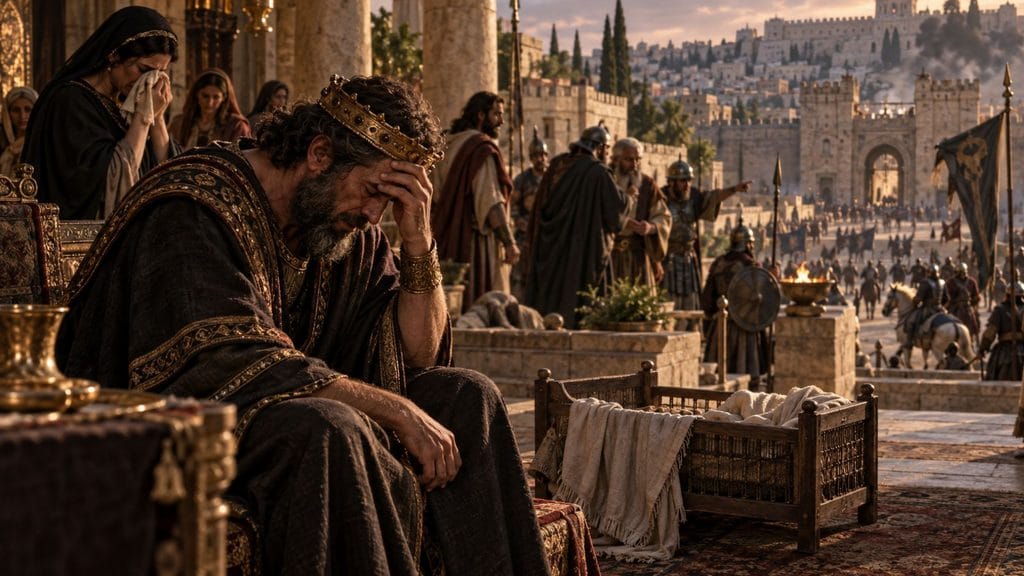
Because of David’s sin, God tells him that violence will continue within his household. The child born from his adultery with Bathsheba dies. Absalom, one of David’s other sons, rebels against him and causes a civil war.
Then King Solomon becomes corrupt later in life and worships other gods. So, David’s household becomes marked by sexual sin, violence, and betrayal.
The Connection Between the Old and New Testaments
Even though David and many of his descendants failed God, God still remained faithful to His promise. Jesus comes from David’s line despite all the tragedy:

“An account of the genealogy of Jesus Christ, the Son of David, the Son of Abraham: … Jesse fathered King David. David fathered Solomon by Uriah’s wife.” — Matthew 1:1, 6 (CSB)
So, biblical theology follows the biblical narrative and helps us connect the points between David and Jesus.
We can also see the whole arc unfolding before our eyes. Honestly, once you start seeing these connections, the Bible becomes even more amazing:
Creation → Israel → David → prophets → Jesus → new creation
The question is:
How does God progressively reveal His promised King and kingdom throughout the biblical story?
Systematic Theology Steps Back and Puts the Pieces Together
Systematic theology gathers everything Scripture teaches about a particular subject and organizes it into clear doctrines. This gives us an easier way to study certain topics and understand how all the pieces fit together.
For instance, you will not find the term “Trinity” anywhere in Scripture. You also will not find one verse explaining the entire doctrine.

Christians believe in one God who eternally exists as three distinct Persons: the Father, the Son, and the Holy Spirit. Each Person is fully God, but there are not three gods. So, how did the Church reach this conclusion?
Well, the branch of systematic theology called theology proper studies God’s nature, attributes, and identity, including the Trinity. It brings together passages such as these:
Matthew 28:19 (CSB)
“Go, therefore, and make disciples of all nations, baptizing them in the name of the Father and of the Son and of the Holy Spirit.”
Matthew 3:16–17 (CSB)
“When Jesus was baptized, he went up immediately from the water. The heavens suddenly opened for him, and he saw the Spirit of God descending like a dove and coming down on him. And a voice from heaven said: ‘This is my beloved Son, with whom I am well-pleased.’”
2 Corinthians 13:13 (CSB)
“The grace of the Lord Jesus Christ, and the love of God, and the fellowship of the Holy Spirit be with you all.”
These passages show the Father, Son, and Holy Spirit together while also showing that They are distinct. Other passages teach us that there is only one God and that the Father, Son, and Holy Spirit are each divine.

Once we connect all these passages, we can clearly see where the doctrine of the Trinity comes from.
You also have other categories like:
- Christology: The study of Christ’s Person, His divine and human natures, His earthly ministry, and His work.
- Pneumatology: The study of the Holy Spirit and His work.
- Soteriology: The study of how we are saved, including grace and atonement.
- Angelology: The study of created spiritual beings, including angels and demons.
- Eschatology: The study of what will happen at the end of history, including Christ’s return, the resurrection, judgment, and the new creation.
So, systematic theology organizes the teachings of the Bible into categories, helping us see how everything Scripture says about a particular subject fits together.
You Already Use Both Without Realizing It
Recently, I started reading Bible Basics for Catholics by John Bergsma. I still have not finished it, but this book is amazing. It explains how God’s plan to save humanity unfolds from the Garden of Eden, through the biblical covenants, and ultimately to Jesus Christ.
As you read it, you start connecting all the points. For instance, the book connects the Garden of Eden with Israel’s tabernacle.

Many biblical theologians understand Eden as the first sanctuary, while the tabernacle later reflects some of its imagery. The Ark of the Covenant stood inside the Most Holy Place, where God made His presence known among Israel.
Now, when I look back, I realize I was studying biblical theology without even knowing it. I’m also reading catechism books, which use an approach more similar to systematic theology because they organize Christian beliefs by subject and doctrine.
In a way, many of us already use both. When people ask us stuff about Christianity, we sometimes even move between the two approaches without realizing it.
If someone asks you, “Why do Christians believe Jesus is fully God and fully human?” you might begin with a systematic approach by connecting several passages, such as:
Colossians 2:9 (CSB)
“For the entire fullness of God’s nature dwells bodily in Christ.”
John 1:14 (CSB)
“The Word became flesh and dwelt among us. We observed his glory, the glory as the one and only Son from the Father, full of grace and truth.”
Colossians tells us that the fullness of God’s nature dwells in Christ, while John tells us that the Word truly became flesh.
Once you connect these verses with others, you begin to understand why Christians believe Jesus is fully God and fully human.
Then you might use biblical theology to explain how God prepared the way for the Messiah throughout the biblical story, of course, if the person listening has patience, lol.
You could start with the fall and then move through Noah, Abraham, Moses and Israel, King David, the prophets, and finally Jesus Christ.
The Two Approaches Need Each Other
So should you study one or another? Or both…
Biblical Theology Keeps Us From Flattening the Bible
Biblical theology prevents us from flattening the Bible, as if everything happened at the same time. God progressively revealed Himself and His plan throughout history until it reached its climax in Jesus Christ.

Without paying attention to that development, we may miss important things like:
- The whole biblical story.
- The historical setting and culture surrounding each passage.
- What people understood about God at that point in His revelation.
- The connections between books like Genesis, Leviticus, John, and Romans without treating them as if they were written at the same moment.
- How earlier promises are fulfilled later in Scripture.
Biblical theology helps us see Scripture as one unfolding story rather than a disconnected collection of passages and doctrines.
Systematic Theology Keeps Us From Building Beliefs on One Passage
Now imagine creating your entire belief about salvation, baptism, judgment, or Jesus from one verse while ignoring everything else Scripture says. Yeah, that would be a problem.

Systematic theology helps us avoid this because it:
- Brings together everything Scripture teaches about a particular subject.
- Organizes related passages and doctrines into categories.
- Gives us a clearer explanation of why Christians believe certain things.
But, as I said before, if we use only this approach and ignore the biblical story, we risk turning the Bible into a large FAQ.
Now, FAQs are helpful. They are usually the first place I go whenever I have a problem. But imagine the entire Bible being written like one.
Our reading of Scripture could become dry and disconnected from the amazing story unfolding within it.
Different Strengths, Same Revelation
Honestly, even though the title says Biblical Theology vs. Systematic Theology, the two are not fighting against each other. Both work together, and each protects us from a different mistake.
For instance, if someone claims that Christians believe in three gods, your systematic theology studies can help you explain clearly why that claim is wrong.
If someone is confused about why we need Jesus, biblical theology can help you explain the story from humanity’s fall, through God’s promises and covenants, and finally to Jesus Christ.
By combining both, you gain a more complete understanding of Scripture and the Christian faith.
Biblical theology helps us see how the pieces develop. Systematic theology helps us see how the pieces fit together.
Last Thoughts
So, which approach feels more natural to you? Do you prefer following a theme throughout the biblical story, or gathering different passages to understand a particular Christian belief?
And what subject would you like to study using both approaches? Honestly, I’d like to know. Share your answer in the comment section below.