
What Is Spiritual Discernment? A Biblical Guide
So, what is spiritual discernment, and how can we develop it?
Many Christians think discernment is mainly about detecting something wrong in another person. Perhaps a preacher teaches false doctrine, someone gives a questionable prophecy, or we meet someone whose motives do not seem right.
But discernment may sometimes begin much closer to home with what is happening inside us.
Around three weeks ago, I suddenly had an itch to continue watching the television series From. I had stopped watching it over a year earlier because it was becoming too heavy. Honestly, looking back, it was not something that glorified God or helped my mind in any good way.
Still, my curiosity got the best of me.
The episode involved Fatima carrying some kind of demonic creature while being held in a basement and fed blood.
While watching it, I began to feel nauseous. Something inside me was saying, “Do not watch this.”
So, I turned it off.
The next day, I wondered whether the character Fatima might be a twisted reference to Our Lady of Fátima. Here in Portugal, Fátima is where the Virgin Mary is reported to have appeared to three shepherd children in 1917.
Was that symbolism intentional? I cannot say for certain.
Can I prove the Holy Spirit warned me that night? No. But I believe He may have been pushing me away from something that was doing me no spiritual good.
That experience reminded me that discernment is not only about examining what is wrong in others. Sometimes it means noticing what is happening within us and testing whether our feelings, desires, and impressions agree with God’s truth.
Key Takeaways
- Not everything spiritual comes from God. Teachings, prophecies, dreams, impressions, and supernatural claims should always be tested rather than accepted automatically.
- Discernment begins with Scripture. God will never contradict His Word or His character. We should examine verses in context instead of building beliefs around isolated passages.
- Our own hearts also need to be tested. Pride, fear, loneliness, anger, and personal desire can influence what we believe God is telling us.
- Discernment is not suspicion. We should not assume hidden motives, accuse people without evidence, or treat every uncomfortable feeling as a spiritual warning.
- Spiritual discernment develops through practice. As we walk with Christ, pray, obey, accept correction, and learn from our mistakes, we gradually become harder to deceive without becoming closed to God.
What Does Spiritual Discernment Mean in the Bible?
Spiritual discernment is our Spirit-formed ability to distinguish between what agrees with God’s truth and what does not. It helps us separate good from evil. Not only in the teachings, situations, and spiritual claims around us, but also in our own thoughts, desires, and behavior.
“Now everyone who lives on milk is inexperienced with the message about righteousness, because he is an infant. But solid food is for the mature for those whose senses have been trained to distinguish between good and evil.”
—Hebrews 5:13–14, CSB
Discernment is also something that develops as we walk side by side with Christ and put His truth into practice. When we first begin our journey, we are often far from discerning. I look back on my first year as a Christian, and I certainly was not very discerning.
For instance, I used to assume that most spiritual manifestations belonged to God. I also watched YouTube videos from people who claimed that God worked through them in miraculous ways.
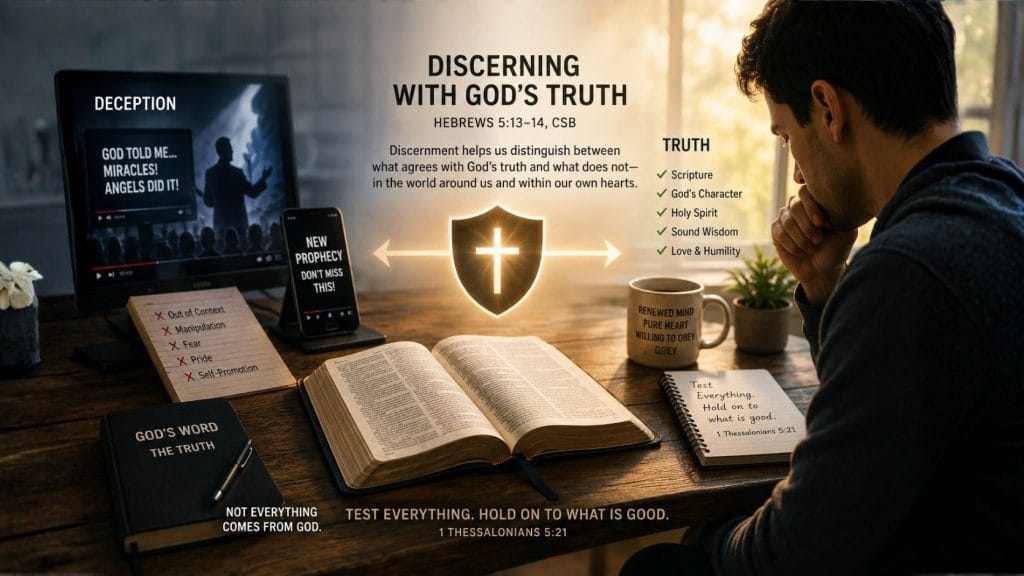
But even then, for some reason, I eventually stopped watching some of them. Something did not feel right.
I still remember one man claiming that his angels had helped him put luggage into the trunk of his car. I had watched many of his other videos, but that one felt so awkward that it became the last one.
At the time, I could not fully explain what was wrong. And an uncomfortable feeling is not proof by itself. But it can make us stop, pay closer attention, and test what we are seeing rather than accepting it automatically. Scripture tells us not to believe every spirit but to test whether it is from God.
So, discernment is not only intellectual. A person can be highly educated and still lack spiritual judgment. Intelligence alone does not make someone discerning.
Spiritual discernment involves a mind and heart renewed by God’s truth. A conscience shaped by holiness, and a willingness to obey God and glorify Him, even when the truth challenges what we want to believe.
Why Christians Need Spiritual Discernment
The quick answer is this: not everything comes from God.
We want to avoid being deceived by false doctrines, questionable spiritual manifestations, or even people who do not have good intentions.
False Teaching Can Sound Christian
Jesus fasted for forty days and forty nights in the wilderness. Afterward, He was hungry, and Satan came to tempt Him.
Interestingly, Satan even quoted Scripture while trying to deceive Jesus. He used God’s Word, but twisted it for his own purpose.
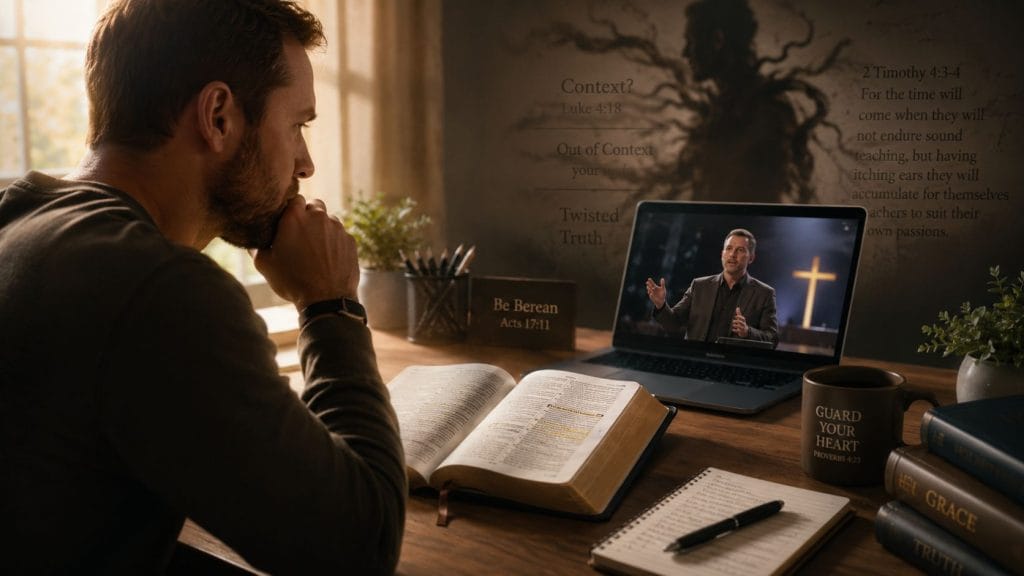
The enemy still tries to do the same today. Many YouTubers, preachers, and online teachers take a Bible verse out of context and use it to support something the passage was never teaching.
That is why we need to guard our hearts and minds. Not everything that sounds Christian or comes from someone who looks reputable is true.
Our Own Hearts Can Mislead Us
Our own hearts can also deceive us. We need to watch for pride, fear, selfishness, anger, and loneliness.
Out of all of these, pride may be one of the most dangerous. We can usually notice when we are afraid, angry, or acting selfishly.
But pride can enter silently, sometimes without us even noticing it.
For example, imagine I am praying for someone, and God moves in a miraculous way. Then a thought enters my mind, “See what you did? You are special.”
If I start watering that seed of pride, sooner or later, I will have a serious problem. I may forget that God is the One doing the work. I am only the person He chose to use in that moment.
“The heart is more deceitful than anything else, and incurable who can understand it?”
—Jeremiah 17:9, CSB
Discernment is not only about examining other people. We must also allow God to show us what is happening inside us.
Some Choices Are Not Directly Addressed by a Bible Verse
Not every decision we face is mentioned directly in the Bible.
Scripture may not tell us which job to accept, where to live, whom to date, or which ministry opportunity to pursue.
However, it gives us the truth and wisdom needed to make those decisions.
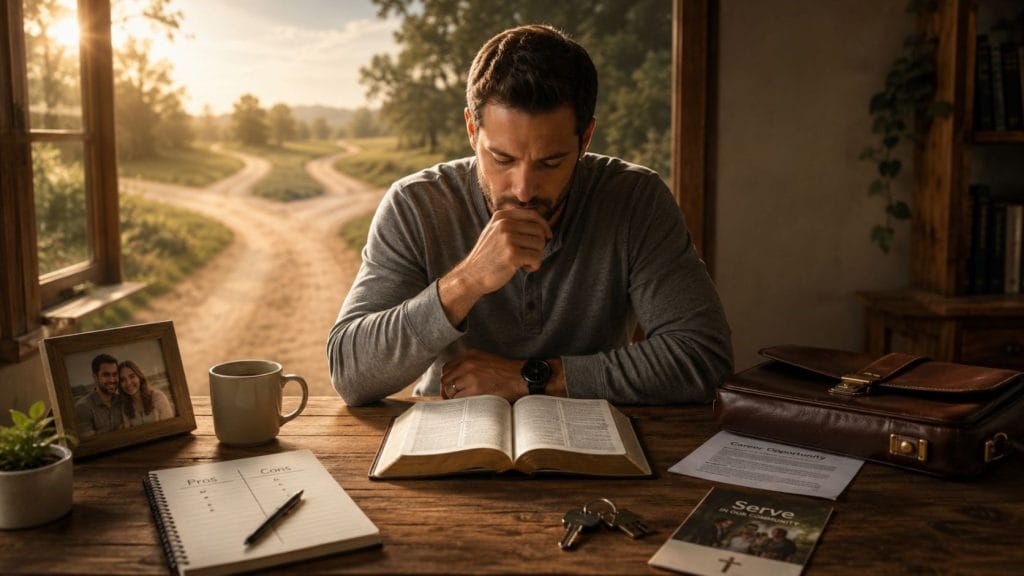
Christ should remain at the centre of our lives. We must consider our motives, responsibilities, possible consequences, and whether a decision will help us obey and glorify God.
The Bible remains our foundation, but applying its teaching to real situations requires wisdom and discernment.
Spiritual Experiences Must Be Tested
Walking with God is itself a spiritual experience.
In my own walk, I have seen more miracles happen in a few years than in all the decades before combined. But I also admit that some things I encountered did not come from God.
We need to be careful.
God will never contradict His Word or act against His character. However, that does not mean everything from God will make us feel immediately comfortable. Sometimes He convicts us. Other times, obedience is difficult.
An uneasy feeling may cause us to stop and pay attention, but the feeling alone is not enough. We must test the teaching, experience, or person instead of accepting it automatically.
This includes the people we follow online.
“Dear friends, do not believe every spirit, but test the spirits to see if they are from God, because many false prophets have gone out into the world.”
—1 John 4:1, CSB
The biblical response is not to accept everything supernatural. It is also not to reject everything immediately.
We test it carefully and hold on to what is good.
Spiritual Discernment Is Not the Same as Suspicion
Many of us begin our Christian walk spiritually naive. I certainly did.
We hear an impressive testimony, prophecy, or supernatural claim, and because it sounds Christian, we assume it must come from God.
I have met people who attended churches with a strong focus on spiritual gifts. I am not against spiritual gifts. I believe they still exist.

The problem is that not every spiritual manifestation comes from God. Some people eventually realize that certain teachings or practices were unhealthy. But then they move radically in the opposite direction and reject spiritual gifts entirely.
Neither extreme is wise.
Being spiritually naive leaves us open to deception. But becoming suspicious of everything may cause us to reject something simply because we do not understand it.
Scripture gives us a better balance:
“Don’t stifle the Spirit. Don’t despise prophecies, but test all things. Hold on to what is good.”
—1 Thessalonians 5:19–21, CSB
Discernment does not mean assuming hidden motives, treating personal dislike as a spiritual warning, believing we can read someone’s heart, or publicly accusing people without sufficient evidence.
True discernment should produce humility, patience, truthfulness, and love rather than pride or constant suspicion.
How to Test a Teaching, Impression, or Decision
I’m still learning, but over the years, I have definitely become more discerning.
Honestly, I did not have anyone close to me teaching these things. Much of it came through research, prayer, and going through difficult situations.
Here are some questions that have helped me.
1. Does It Agree With Scripture?
God will never contradict His Word. The Holy Spirit is the Spirit of truth, and God’s character does not change.
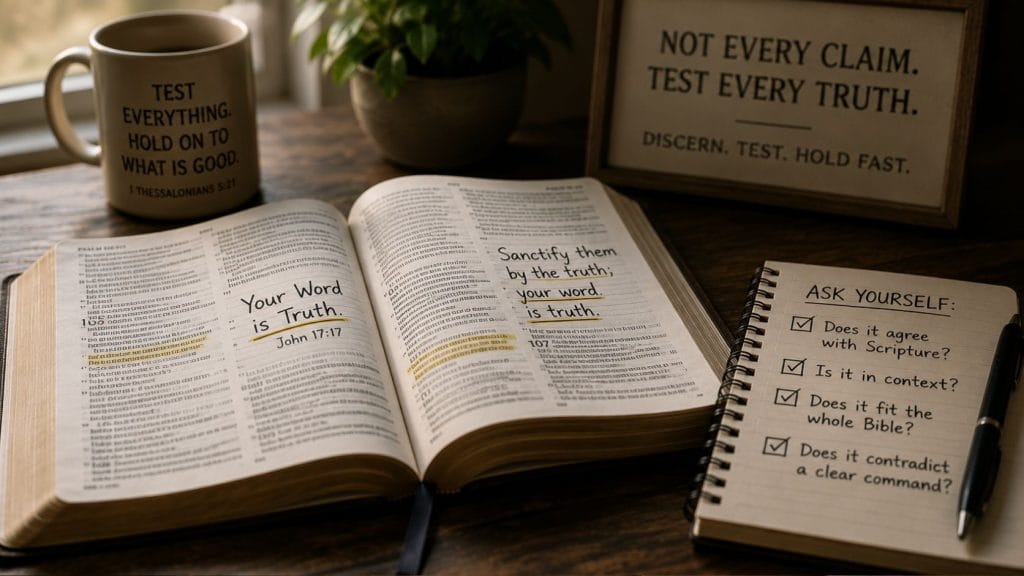
So, ask yourself:
- Does this depend on an isolated verse?
- Does it fit the wider teaching of Scripture?
- Is the passage being read in context?
- Does it contradict a clear Christian command?
Something we commonly hear nowadays is, “God is love.” Therefore, some people believe they can do whatever they want.
Yes, God is love. But love does not mean tolerating everything.
A loving father will not allow his children to do whatever comes into their minds, especially when he knows it will harm them. Scripture also teaches that God is holy and just.
We cannot use one truth about God to erase everything else He has revealed about Himself.
2. Does It Agree With the Truth About Christ?
A teaching may quote Scripture and still present a distorted version of Jesus.
Ask what it teaches about:
- Who Jesus is.
- His incarnation.
- His death and resurrection.
- Sin and salvation.
- Grace and repentance.
- Christian obedience.
We often see teachers speaking about “God,” spiritual experiences, blessings, purpose, and success while presenting very little of the actual gospel.
Jesus is not merely a teacher, example, or source of blessings. He is the Son of God who became human, died for our sins, rose from the dead, and calls us to repentance and faith.
3. What Fruit Does It Produce?
One of the most important questions is not whether something feels powerful, but what kind of person it is forming us to become.
Does the teaching or spiritual experience help us become more like Christ?
Of course, we do not always grow through easy moments. Some of the hardest seasons of my life were also the moments when I had to rely on God the most.
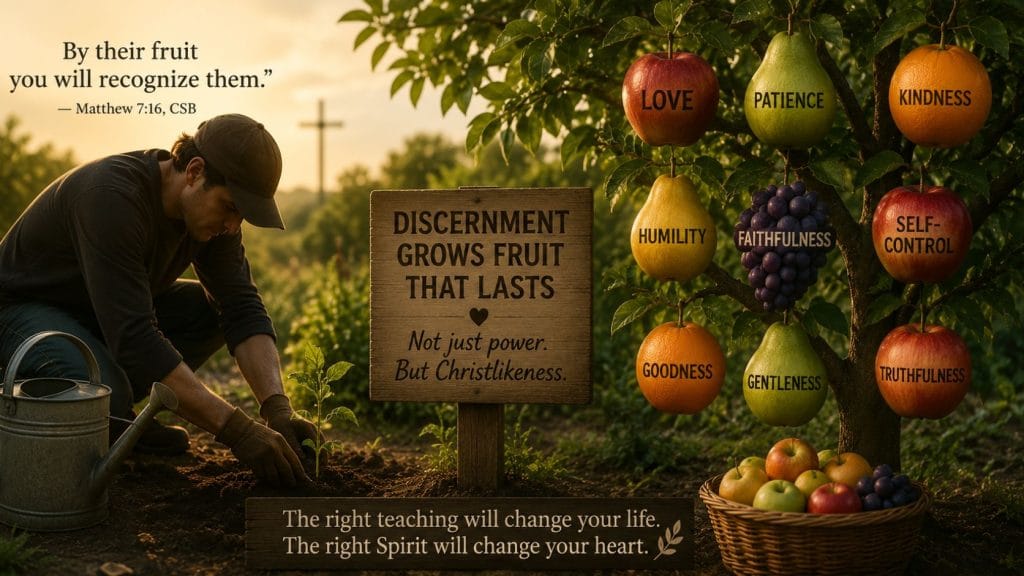
Over time, healthy teaching should produce fruit such as:
- Holiness.
- Humility.
- Love.
- Repentance.
- Truthfulness.
- Self-control.
- Faithfulness.
We should not judge a teacher by popularity, wealth, charisma, supernatural claims, or rapid growth.
Instead, ask: Does this person consistently show love, patience, humility, self-control, and compassion?
A public image can be created quickly. Christian character must be demonstrated over time.
4. What Is Happening in My Own Heart?
We should always examine ourselves first. We should also be careful about the influence of the people around us.
A few years ago, I regularly spoke with a woman who loved talking behind other people’s backs. Of course, she usually painted herself as the good person in every situation.
Eventually, I noticed that I had started participating in those conversations without even realizing it.
So, ask yourself:
- Do I want this to be true because it benefits me?
- Am I responding from fear or resentment?
- Am I looking for permission rather than guidance?
- Would I accept the same reasoning if it led to a harder answer?
- Am I willing to obey God if His answer is not what I hoped?
Sometimes the greatest obstacle to discernment is not a false teacher or an outside influence. It is our unwillingness to accept an answer we do not like.
5. What Do Mature Christians See?
We should also seek guidance from mature Christians.
Knowing theology is important, but knowledge alone does not automatically produce wisdom. Look for people whose understanding of Scripture is joined with prayer, humility, obedience, and Christian character.

Seek counsel from Christians who:
- Know Scripture.
- Demonstrate mature character.
- Are not personally benefiting from the decision.
- Are willing to disagree honestly.
- Understand the circumstances.
The purpose is not to collect opinions until someone finally confirms what we already want.
Sometimes the most valuable person is the one willing to tell us, “I do not think this is wise.”
6. Can It Withstand Time and Prayer?
We should not rush important decisions.
I know that not every decision can be delayed. Sometimes we must respond immediately. But often, that is not the case.
I have noticed that temptation and poor decisions often come with emotional pressure:
“You need to decide now.”
Whether that pressure is spiritual or simply emotional, rushing can prevent us from thinking clearly.
Ask whether the apparent guidance still makes sense after:
- Prayer.
- Reflection.
- Gathering more information.
- The emotional intensity has decreased.
- Speaking with trustworthy Christians.
Feeling peace does not automatically prove that a decision comes from God. People can feel peaceful about unwise choices, while obedience can sometimes involve fear, grief, or difficulty.
When possible, allow important decisions to be tested through Scripture, prayer, time, wise counsel, and the facts of the situation. We do not need to force signs or interpret every coincidence as confirmation.
7. Spiritual Discernment Grows Through Practice
Spiritual discernment comes with time.
I often pray and ask God to give me discernment. But I have noticed that when we pray for it, at least in my experience, it is not as though we wake up the next morning spiritually bulletproof.
Instead, God often allows us to face situations where we need to practice discernment. In those moments, we may need to remember what Scripture teaches, slow down, pray, or pay attention to an inner warning.
Like I mentioned earlier with the television series From, I felt something inside telling me to turn it off. That feeling was not proof by itself. But it was enough to make me stop and consider whether what I was watching was spiritually healthy.
Discernment grows as we practice it: testing things against Scripture, learning from our mistakes, and obeying what God has already made clear.
“But solid food is for the mature for those whose senses have been trained to distinguish between good and evil.”
—Hebrews 5:14, CSB
Final Thoughts
Spiritual discernment takes time to develop. None of us will get everything right, and we should be humble enough to admit when we may have misunderstood something.
Still, as we remain close to Christ, learn Scripture, pray, and pay attention to what is happening inside us, discernment gradually becomes clearer.
The goal is not to fear everything spiritual. It is to recognize what comes from God and have the courage to reject what does not.
1. Is Discernment Different From the Gift of Discerning Spirits?
Yes, although they are related. Every Christian is called to grow in discernment, test teachings, and learn to distinguish good from evil.
However, 1 Corinthians 12:10 also mentions the specific spiritual gift of “distinguishing between spirits,” which the Holy Spirit gives to certain believers for the good of the Church.
Christian traditions differ on exactly how this gift works. But it is often connected with recognizing whether a prophecy, teaching, or spiritual manifestation truly comes from God.
2. How Do You Activate Spiritual Discernment?
Spiritual discernment is not something we activate like turning on a switch. We grow in it by asking God for wisdom, reading Scripture in context, obeying what He has already revealed, praying, receiving correction, and practicing discernment in real situations.
As I mentioned earlier, we do not normally wake up one morning spiritually bulletproof. Our senses are gradually trained as we walk with Christ and learn to distinguish good from evil.
3. What Are the Seven Gifts of Discernment?
The Bible does not give us a list called the “seven gifts of discernment.” This question probably comes from the traditional seven gifts of the Holy Spirit: wisdom, understanding, counsel, fortitude, knowledge, piety, and fear of the Lord.
These gifts can certainly help a Christian become more discerning. But they should not be confused with seven separate kinds of discernment.
First Corinthians 12 mentions “distinguishing between spirits” as one particular spiritual gift.
4. Is Discernment a Skill or a Gift?
In one sense, it is both. General Christian discernment is an ability that all believers should develop through Scripture, prayer, obedience, experience, and spiritual maturity.
Hebrews says that mature Christians have trained their senses to distinguish between good and evil.
At the same time, “distinguishing between spirits” is described as a particular gift distributed by the Holy Spirit. So, every Christian should become more discerning, but not everyone necessarily receives the same spiritual gift or exercises it in the same way.
