
7 Simple Bible Study Methods for Beginners
Have you ever opened the Bible and wondered, “Okay… how am I actually supposed to study this?”
I guess, like most people, when I started reading the Bible, I did the same as I did with any other book. I grabbed my Bible and read page after page until I finished the New Testament, then moved on to the Old Testament.
Is there something wrong with this? Nope, you can do this. And it’s a great way to get yourself involved in the Word of God. But as time passes, you notice that maybe you can apply other methods to understand Scripture better.
After spending some time researching and testing different approaches, I’ve realized that choosing a Bible Study Method does not need to be complicated. You don’t need ten highlighters, a desk filled with commentaries, or some strange acronym that you can barely remember.
Here’s the thing: the method you choose should depend on what you want to understand. Maybe you want to examine a difficult passage, study someone from the Bible, understand an entire book, or simply use an easy method each morning.
In this guide, we’ll explore seven simple methods, how each one works, and when you may want to use it. You do not need to learn all seven at once. Choose the one that seems more useful for what you want to understand, open your Bible, and start from there.
1. Inductive Bible Study — When You Want to Understand a Passage
This first method consists of looking closely at a passage before deciding what it means. Basically, you follow three steps:
Observation: What does the passage actually say? You want to notice who is speaking, what happens, any repeated words, and other important details.
Interpretation: What does it mean in its context? Now consider the surrounding verses, historical setting, cultural differences, and what the author was trying to communicate to his original audience. The passage was not written directly to us nearly 2,000 years later, but God preserved it for our instruction.
Application: How should I respond? Look at what the passage teaches and consider how you can put it into practice.
For example:
Jesus entered the synagogue again, and a man was there who had a shriveled hand. In order to accuse him, they were watching him closely to see whether he would heal him on the Sabbath.
He told the man with the shriveled hand, “Stand before us.” Then he said to them, “Is it lawful to do good on the Sabbath or to do evil, to save life or to kill?” But they were silent. After looking around at them with anger, he was grieved at the hardness of their hearts and told the man, “Stretch out your hand.”
So he stretched it out, and his hand was restored. Immediately the Pharisees went out and started plotting with the Herodians against him, how they might kill him.
—Mark 3:1–6 (CSB)
1. Who Is Present?
Jesus, a man with a shriveled hand, the Pharisees, and eventually the Herodians. Now we know who is involved in this situation.
2. What Happens?
A man has a shriveled hand. The Pharisees are watching Jesus closely because they want to accuse Him of violating their understanding of the Sabbath.
Jesus calls the man forward and asks whether it is lawful to do good or evil on the Sabbath. After they refuse to answer, Jesus heals the man. Immediately afterward, the Pharisees begin plotting with the Herodians to kill Him.
3. What Conflict Is Taking Place?
The Pharisees are more concerned with accusing Jesus than with seeing the man healed. Jesus confronts their rigid interpretation of the Sabbath by asking whether the day should be used to do good or evil, to save life or to kill.
Their silence makes Jesus angry and grieves Him because it reveals the hardness of their hearts.
4. What Does Jesus Claim or Reveal?
If we read the surrounding context, Jesus had already said:
“So then, the Son of Man is Lord even of the Sabbath.”
—Mark 2:28 (CSB)
Jesus reveals His authority as Lord of the Sabbath. He does not disobey God’s law. Instead, He challenges the Pharisees’ distorted interpretation of it.
God did not give the Sabbath so people could use it as an excuse not to help someone. Jesus shows that doing good and helping those in need is never against God’s will.
5. How Can I Apply This Teaching to My Life?
I should not use religious rules, traditions, or fear of criticism as an excuse to ignore someone who needs my help. I should also look at my own heart and ask, “Am I more concerned with catching other people doing something wrong than with doing good myself?”
Best for: learning how to examine a passage carefully before deciding what it means and how to apply it.
2. SOAP — When You Want a Simple Daily Method
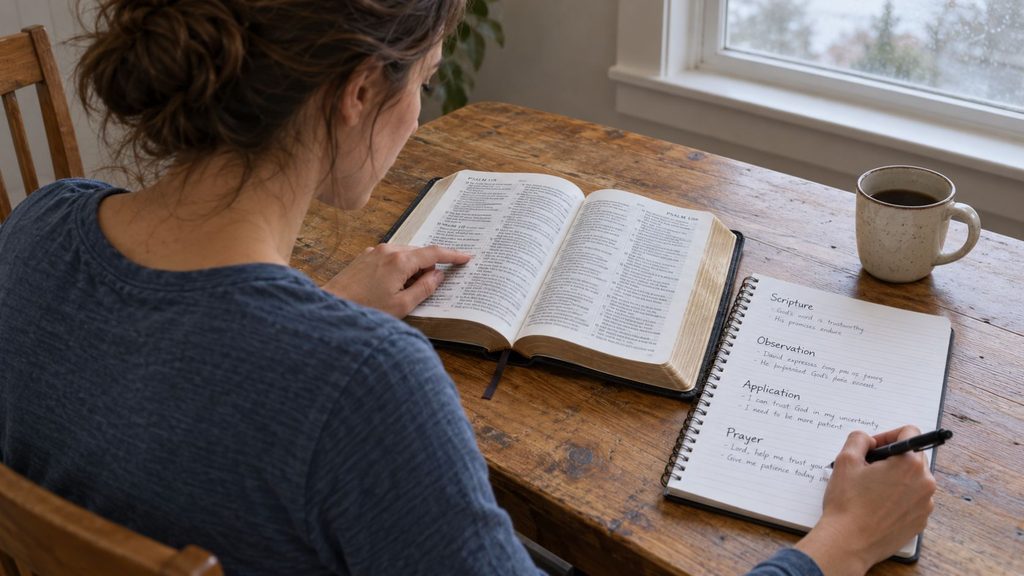
I guess many of us use some version of this method without even noticing it. And yes, that’s how simple it is. If the previous method seems like too much for a normal day, then SOAP may be easier to follow.
SOAP stands for:
S — Scripture: Read a short passage and write down a verse that catches your eye.
O — Observation: What is happening in the passage? Who is speaking, and what seems important?
A — Application: Pause for a moment and ask yourself, “How can I apply this teaching to my life?”
P — Prayer: Respond to what you read by speaking with God. You can ask Him to help you apply the teaching or give you a more Christlike heart.
For instance, when I read about Jesus in the Garden of Gethsemane, I pause for a moment and think about how humble and obedient He was to His Father, even though He knew the suffering that was about to come.
I then pray and ask God to give me a humble and obedient heart so I can follow His will, even when I do not fully understand it.
But a word of caution: just because one verse catches your eye does not mean your first impression is automatically its correct meaning. Read the surrounding passage before applying it to your life.
Best for: a simple daily study in which you read a short passage, reflect upon it, and respond to God in prayer.
3. Book Study — When You Want to See the Bigger Picture
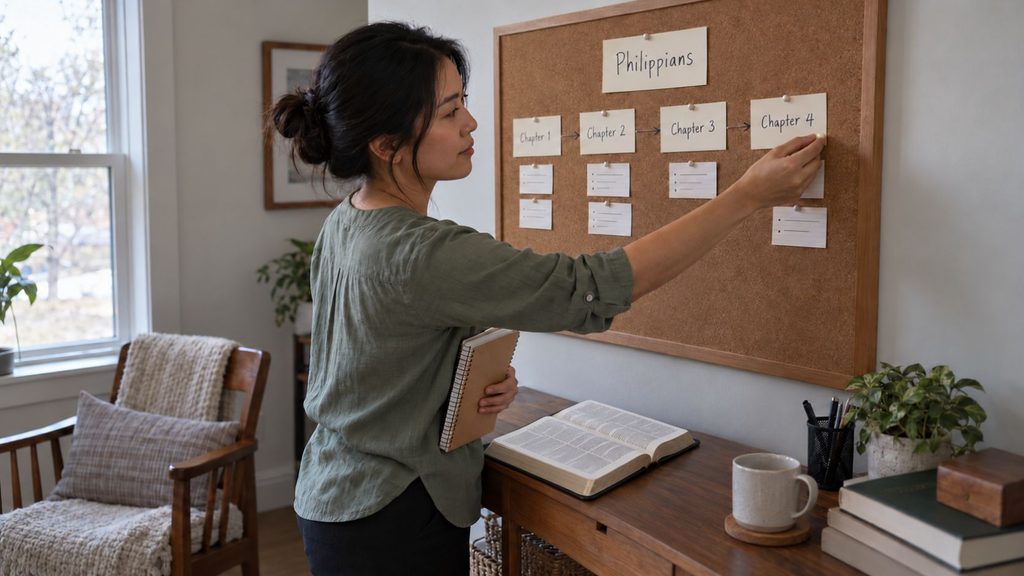
Instead of focusing mainly on a short passage, as we did before, we can study one biblical book. This helps us go deeper into the context, understand why the author wrote it, and see how each passage fits into the larger message. We also begin to notice what makes each book so marvelous.
Here are some of my personal favorites. Of course, you can choose another book. After all:
“All Scripture is inspired by God and is profitable for teaching, for rebuking, for correcting, for training in righteousness,”
—2 Timothy 3:16 (CSB)
- Philippians: Paul encourages Christians to remain joyful, united, and faithful to Christ even while facing hardship.
- James: James gives practical teachings about living out our faith through our actions, speech, patience, and how we treat others.
- Romans: Paul explains humanity’s problem with sin, salvation through Jesus Christ, life in the Holy Spirit, and how Christians should live after receiving God’s grace.
- 1 John: John helps Christians recognize the truth about Jesus, resist false teachings, love one another, and have assurance that they belong to God.
Romans is a bit more complex, so I would not necessarily suggest starting there. Philippians, James, or 1 John may be easier if this is your first time studying an entire book.
I suggest reading the whole book first, or at least a large portion, before diving into the details of individual passages. You want to notice the following:
- Who wrote the book and to whom
- Why the book was written
- Repeated themes
- Major sections
- Problems being addressed
- How the argument or story develops
Even though this may sound similar to normal Bible reading, it goes deeper into the core of the book. You begin to notice details, connections, and repeated ideas that you probably would not see by simply reading from one page to another.
Best for: understanding the larger message of a biblical book before studying its individual passages.
4. Topical Study — When You Have a Question
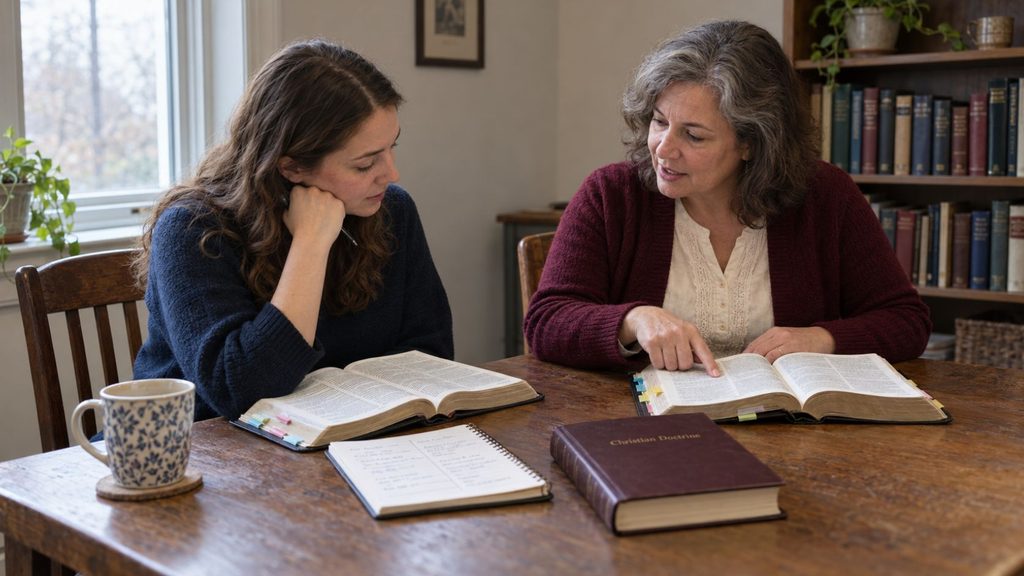
I personally use this method quite often. It helps me go deeper into specific biblical topics, especially the core doctrines of our faith.
For instance, it helps us move from, “Okay, I have an idea that Jesus is the way to salvation,” to, “I understand why Christians believe that Jesus is our Savior.”
“Today in the city of David a Savior was born for you, who is the Messiah, the Lord.”
—Luke 2:11 (CSB)
Of course, that is only one verse among many. But as you begin putting the passages together, your understanding becomes more solid instead of having these ideas floating around in the air.
You can use topical study for nearly anything you may be curious about, such as:
- What does the Bible teach about forgiveness?
- What is biblical wisdom?
- Why is God called “holy, holy, holy” three times in a row?
- What does Scripture say about prayer?
Let’s say you want to understand why Christians believe Jesus is fully man and fully God. You can begin with a Google search for “Jesus fully man and fully God Bible verses.”
You’ll probably find passages such as John 1:1, John 1:14, Colossians 2:9, Philippians 2:6–8, and 1 Timothy 2:5.
Google can help you locate the passages, but it should only be your starting point. A list of verses does not interpret those verses for you.
Here’s the danger with this method:
It’s easy to collect only the passages that support what you already believe. Then you end up using Scripture to prove your own opinion rather than allowing Scripture to teach you.
After gathering the relevant passages, read what comes before and after each one. Look for verses that may challenge or add something to your first conclusion. You can then study how the early Christians understood these passages and eventually expressed this teaching more clearly.
You can also read a catechism, official Church teaching, or a statement of faith from your Christian tradition. Once you reach the end, I’m telling you, you’ll have a solid understanding of that teaching than when you started.
Best for: answering a particular biblical, theological, or practical question by studying several passages connected to the same subject.
5. Character Study — When You Want to Follow a Person’s Story
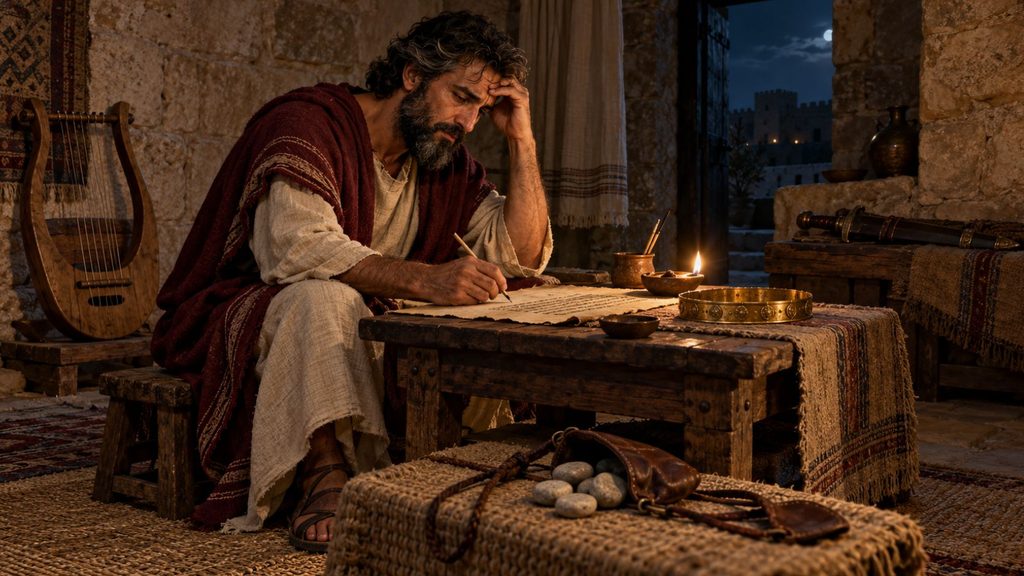
This is a unique way to study specific people in the Bible, and believe me, you can learn a lot. One person I’ve always found fascinating is King David, especially because God says this:
“I have found David the son of Jesse to be a man after my own heart, who will carry out all my will.”
—Acts 13:22 (CSB, excerpt)
Intriguing, right? How could David be described as a man after God’s heart even though he disobeyed God, committed adultery with Bathsheba, and arranged for her husband, Uriah, to die in battle?
Those are the kinds of questions this study focuses on. In this example, we can examine what made David so dear to God, but also what he did wrong and, well, which steps we should not repeat.
Of course, you can choose anyone from the Bible whom you find fascinating, such as:
- Mary, the Mother of God
- The Apostle Peter
- Ruth
- Joseph, the son of Jacob
- Esther
- Mary Magdalene
Once again, you can use Google, BibleGateway, cross-references, or a concordance to find passages connected to the person you chose. Then, as you read each passage, ask yourself:
- How do they change?
- Where do they fail?
- How does God deal with them?
- What part do they play in the larger biblical story?
- What does their story reveal about God?
It’s a fantastic way to study the Bible because you get to see both the good and bad sides of each person. You notice their faith and courage, but also their weaknesses, poor choices, and consequences.
You can even turn something you learned into prayer. If you notice that you lack courage in a specific situation, you might pray, “Please, Lord God, give me courage like David had when he faced Goliath.”
Best for: following someone’s growth, failures, relationship with God, and story throughout Scripture.
6. Verse Mapping — When One Verse Makes You Stop
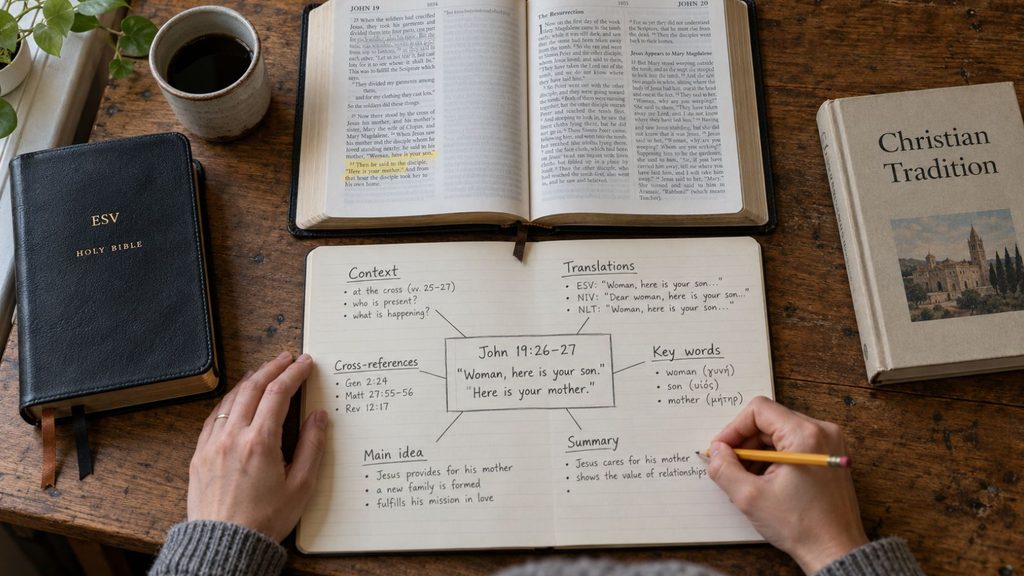
So, you’re reading the Bible and stumble upon a verse that you find confusing—what now?
If you have time, stop before moving on. You may learn something important by studying that verse more closely. For example:
When Jesus saw his mother and the disciple he loved standing there, he said to his mother, “Woman, here is your son.” Then he said to the disciple, “Here is your mother.” And from that hour the disciple took her into his home.
—John 19:26–27 (CSB)
You may stop after reading these verses and think:
Wait… did Jesus just tell Mary and the disciple He loved, understood to be John, that they were now mother and son? What does this mean? How could Mary be his mother?
Next, you can do the following:
- Write the verse down in a notebook or on your mobile—whatever you have nearby
- Read the paragraph around it
- Compare a few reliable Bible translations
- Notice important words
- Follow useful cross-references
- Identify the main idea
- Summarize it in your own words
Doing this can help you understand the passage more clearly, although it may not remove every question immediately.
In this case, you may continue researching and discover why the Catholic Church understands this passage as revealing Mary’s spiritual motherhood toward believers. You can look at how the early Church and later Christian tradition understood these words.
Meanwhile, you do not need to spend thirty minutes researching ancient Greek words while ignoring what the verses themselves mean. Context comes before interesting word definitions.
Best for: slowing down and investigating one important or confusing verse more carefully.
7. Biblical Meditation — When You Need to Stop Rushing

If you normally set time aside to pray, you can try this method. For this, you do not need to take notes, understand definitions, read commentaries, or look at diagrams.
Sometimes, you already understand the basic meaning of a passage. Now you simply need to remain with it and let it sink in.
For example:
In those days Jesus came from Nazareth in Galilee and was baptized in the Jordan by John. As soon as he came up out of the water, he saw the heavens being torn open and the Spirit descending on him like a dove. And a voice came from heaven: “You are my beloved Son; with you I am well-pleased.”
—Mark 1:9–11 (CSB)
Biblical meditation is not about emptying your mind and waiting for whatever appears. Instead, you fill your mind with the Word of God.
You can read the passage slowly several times, repeat it, and consider what it reveals. In this case, I may think about the humility and obedience of Jesus. Even though He was without sin, He allowed John to baptize Him.
We also see the Father, the Son, and the Holy Spirit revealed in the same scene. I can remain with those truths for a while and then respond to God in prayer.
The goal is not to discover some secret meaning. It is to allow a truth you already understand to sink deeper, as God transforms your heart, mind, and whole being more into the image of Jesus.
Best for: allowing Scripture to sink deeper into your heart and become part of your prayer.
Which Bible Study Method Should a Beginner Start With?
What makes the most sense to you at the moment?
There is no single method that every beginner must use. It depends on what you want to understand and how much time you have.
| If you want to… | Try this method |
|---|---|
| Understand a passage carefully | Inductive Bible Study |
| Follow a simple daily routine | SOAP |
| Understand the larger message of one book | Book Study |
| Answer a biblical or theological question | Topical Study |
| Follow the life of someone in Scripture | Character Study |
| Investigate one confusing or important verse | Verse Mapping |
| Slow down, reflect, and pray with Scripture | Biblical Meditation |
Honestly, if you have never studied the Bible before, I suggest starting with the inductive method. It teaches you to notice what the passage says before jumping to conclusions about what it means.
But if that feels like too much at the moment, begin with SOAP. It’s simple, practical, and you can use it without turning your kitchen table into a theological library.
I also suggest starting with a shorter book, such as Philippians, James, or 1 John. You do not need to begin with Leviticus and spend the next three weeks wondering what you got yourself into.
You May Change Method As You Go
Also, do not feel trapped inside one method. You may begin with a book study, find one confusing verse, and then use verse mapping to examine it. Or you may finish studying a passage and spend a few minutes meditating and praying about what you learned.
The method is simply a tool. Choose one, open your Bible, ask God for wisdom, and begin. You’ll discover what works best for you as you continue practicing.
Last Thoughts
Studying the Bible may feel overwhelming at first, but you do not need to understand everything immediately. Choose one method, ask God for wisdom, and start.
Which Bible study method do you currently use? Is there one from this list you want to try? Leave your experiences and questions in the comment section below.