
How to Trust God When It’s Hard: A Biblical Guide
Can you still trust God when it feels like He’s forgotten you?
Everything is fine and dandy when things are going well. Trusting God in those moments feels easy. We go to church, talk with people, listen to sermons. Some of them may even be about this exact topic and read our Bible about men and women overcoming complicated times.
Now, it’s all fine until hard times knock at our door.
Then things quickly change, especially when our challenges last not one day, but months or even years. You look ahead and only see the desert and wonder, “Where is the promised land? The land flowing with milk and honey?”
And this lingering thought keeps coming back: “Can I still trust God? Does He even care? Look at me. My life looks like a mess.”
In this guide, we’ll look at what biblical trust means and how to keep trusting God when the road ahead makes little sense.
Key Takeaways
- Trusting God does not mean understanding everything He is doing. It means relying on His wisdom and faithfulness even when the road ahead makes little sense.
- Hard seasons expose how much we want certainty and control. We cannot always see the outcome, prayers may seem unanswered, and pain can make us question what we believe about God.
- You can trust God and still ask hard questions. Doubt, grief, fear, and frustration can be brought honestly to God without turning your back on Him.
- Trust what God has actually promised, not the outcome you hope He will give you. God may change the situation, but our faith should not depend on getting the ending we want.
- Do what is in your hands and give God the rest. Pray, seek help, take the next faithful step, and surrender the timing, other people’s decisions, tomorrow, and the final outcome to Him.
What Does It Actually Mean to Trust God?
Trusting God does not mean understanding everything He is doing. It means relying on His wisdom and faithfulness even when we cannot see the full picture.
I learned some of this during one of the worst periods of my life.
I came to Christ a few years ago, not through the easiest moment of my life. I had hit rock bottom.
I was dating someone I should not have. She was involved in the occult, even though I had little understanding of it. It was a time of intense suffering and confusion.
I mean, one day to the next, you’re faced with the spiritual world when you’ve been living most of your life in a box.
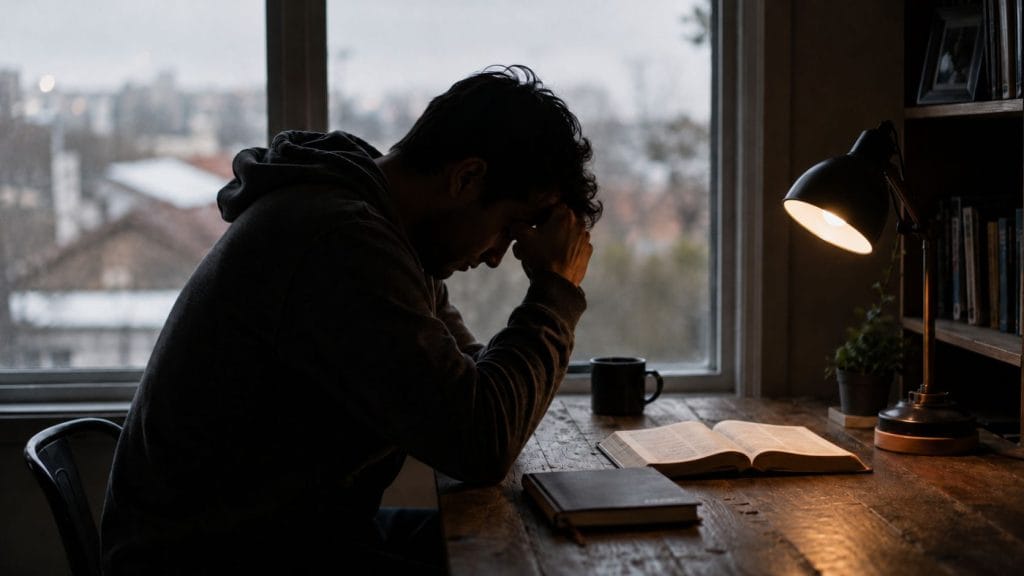
Now, years later, I can sleep well at night. I have joy and peace I never had before.
But back then, I had none of that.
God met me in that rock-bottom season and brought an agnostic like me to Him and to His salvation. Looking back, I can also see how that season changed my character and brought me closer to Him.
At the time, though, I could not see any of that.
That is one reason this passage makes so much sense to me:
“Trust in the Lord with all your heart, and do not rely on your own understanding;
in all your ways know him, and he will make your paths straight.”
—Proverbs 3:5–6, CSB
We naturally want to understand what is happening. We want to know why God allowed this, where everything is going, and preferably when the problem will finally end.
But sometimes we simply do not have those answers.
Why Is It So Hard to Trust God During Difficult Seasons?
First, we are human. Most of us will not have an experience like the apostle Paul. On the road to Damascus, a light from heaven flashed around him, and Jesus spoke to him.
We like to see before we believe.
We Cannot See the Outcome
When we are facing hard challenges, we don’t have Jesus giving us private one-on-one sessions explaining everything that is about to happen.
So, we struggle with believing in God without being able to see Him or know where everything is going.

Especially in such a materialistic society, we are used to having things we can touch and see. Trusting God requires us to shift our minds to believe in what we cannot see, touch, or even sometimes feel.
Prayer May Appear Unanswered
We pray and pray, but nothing seems to happen. In fact, sometimes the opposite of what we prayed for seems to happen.
Then we question, “Where is God? Is anybody out there?”
Even Paul experienced something like this. He repeatedly asked God to remove what he called a “thorn in the flesh,” but God did not remove it. Instead, God told him:
“My grace is sufficient for you, for my power is perfected in weakness.”
—2 Corinthians 12:9, CSB
Sometimes God answers differently from what we expected. His timing is not ours, and we do not always understand what He is doing. That makes trust difficult.
Pain Can Challenge What We Thought We Understood About God
When we think about God, usually one word pops into our minds immediately: love.
But part of the problem is our understanding of love. We can easily begin thinking that love means, “Good things should always happen to me.”
So when things get tough, we question God’s love.
But God being our perfect Father does not mean He promises us a life without suffering. Sometimes He can even use difficult situations to teach us, correct us, or change something in us.
That does not mean we will always understand why a particular hardship happened.
Fear Makes Control Feel Safer Than Dependence
When we are afraid, it often comes from having little control over what is happening in our lives. It is like sitting on a train going somewhere while having no control over its direction.
In those moments, we have to trust the driver—in this case, God to guide us. That is not easy. We want something concrete to hold onto. We want some power over the outcome.
But following God sometimes requires us to admit, “I cannot control where all of this is going.” We have to surrender the steering wheel to Him.
You Can Trust God and Still Ask Hard Questions
Trusting God does not mean pretending everything is alright. Or never having doubts about God.
In my particular situation, I faced three very challenging years. It was at the beginning of my walk. Some days, I doubted God. In some of those moments, I asked Him, “What do You want from me, God?”
We have a tendency to do that. Even David asked hard questions:
“How long, Lord? Will you forget me forever? How long will you hide your face from me?
How long will I store up anxious concerns within me, agony in my mind every day?
How long will my enemy dominate me?”
—Psalm 13:1–2, CSB
Job also wrestled deeply with what God was allowing him to go through. He could not understand why he was suffering and repeatedly questioned God.
Throughout Scripture, we see people feeling confused, grieving, afraid, and frustrated. There really is “nothing new under the sun.”
But despite my situation, mine was nothing compared with what David or Job experienced; I never completely turned my back on God and said, “Enough is enough. Goodbye, Jesus!”
I had doubts, yes. But I kept coming back to Him.
David and Job also continued bringing their pain and questions to God rather than simply walking away from Him.
In those hard days, you can pray and ask God:
- “I do not understand. Why is this happening?”
- “Why am I sick? Financially broke? Why did I lose my job? I keep trying, but nothing changes. Why don’t You do something?”
Now, we may or may not receive the explanation we are looking for. Job certainly did not receive an immediate explanation for everything that happened to him. And sometimes God may respond in a way we did not expect.
The thing is, we can have doubts, fears, and questions. We can even feel angry with God and bring that anger honestly to Him.
But one thing we should keep in our hearts is this:
“For I am persuaded that neither death nor life, nor angels nor rulers, nor things present nor things to come, nor powers, nor height nor depth, nor any other created thing will be able to separate us from the love of God that is in Christ Jesus our Lord.”
—Romans 8:38–39, CSB
Our questions may remain for a while, but they do not mean God has stopped loving us.
Trust What God Has Revealed, Not What You Wish He Had Promised
Sometimes our disappointment comes from expecting something God never actually promised.
For example, in my case, God never promised me I would not suffer intense spiritual warfare. He never promised that my business would not collapse or that some days I would not feel so exhausted that I could barely function.
Actually, and shamefully, I admit, I blamed God for some of those things. Though I have long repented.

Here’s the issue: we live in a fallen world where sin and death entered. Sickness, brokenness, suffering, and all sorts of problems are part of the world we live in.
Scripture connects sin with death and describes creation itself as living under decay while awaiting restoration.
Following Christ does not mean all of that suddenly disappears from our lives. Jesus Himself said:
“You will have suffering in this world. Be courageous! I have conquered the world.”
—John 16:33, CSB
However, not to make things sound just dramatic and hopeless, our hope is in God.
Look at what Shadrach, Meshach, and Abednego told King Nebuchadnezzar:
“If the God we serve exists, then he can rescue us from the furnace of blazing fire, and he can rescue us from the power of you, the king. But even if he does not rescue us, we want you as king to know that we will not serve your gods or worship the gold statue you set up.”
—Daniel 3:17–18, CSB
We should trust what God has revealed rather than build our faith around our own thoughts or emotions about what He should do.
Our thoughts and emotions can be unreliable, especially when we are going through something intense.
That is why we need something more solid to stand on.
In this passage, we can see that their faith is in God, not in a guaranteed outcome. They know God can rescue them. But they do not make their faithfulness depend on Him doing it.
Give God the Outcome and Take the Next Step
Some of our flaws are only revealed to us in our darkest moments.
Coming back to what I said before, when everything is good, everyone can easily beat their chest while saying, “No, no, I fully trust God. I fully rely on Him…”
Do you now?
I thought the same way until one day I spoke with a friend of mine, and he brought some clarity to the spiritual warfare I was going through. I saw that I still had a tendency to want to control things.
I wanted to know what would come next. What God would do next. After that conversation, eventually reality hit me.
I remember walking down the street and praying, “God, look, I do not understand anything. I do not know why I’m suffering through this. I give everything to You.”
Do What Is Actually in Your Control
Even though we do not have control over many things, there are still things we can choose to do:
- Pray: We can choose to spend time with God. We can ask Him to help us overcome negative thoughts we may have about Him, give us strength, and protect us during spiritual warfare.
- Seek help: The Christian walk is not meant to be made alone. We can talk with our church leader or mature Christians for advice and ask friends to pray for us.
- Have the difficult conversation: If we are having difficulties with someone, we can be honest with them. We cannot control their answer, but we can choose to confront the situation wisely.
- Go to the doctor: If we are facing sickness, we can choose to go to the doctor and seek help.
- Apply for the job: If we lost our previous job, we can search and apply for another one.
- Correct something in your life: If you’re struggling with temptation or sin, you can ask God for strength and take practical steps to change what needs changing.
- Be thankful: Look at the good things you already have in your life and thank God for them. This can slowly shift our attention from only seeing our problems to also noticing what God has already given us.
Trusting God does not mean sitting around doing nothing. Sometimes the next faithful step is something very ordinary.
Give God What You Cannot Control
Other things are outside our control, and those are the things we need to give to God.
I know it’s not the easiest choice, but trying to control things we simply cannot control can add even more weight to our suffering.
- Other people’s decisions: We cannot choose how other people will respond. So, give that part to God.
- Whether someone changes: We may pray for someone for years, but we cannot force that person to change. They are responsible for how they respond to God and to the people around them.
- Spiritual warfare: When you go through serious spiritual warfare, you quickly realize how dependent you are on God. You can pray, ask others to pray for you, resist temptation, and seek support, but ultimately our strength comes from Him.
- How quickly circumstances improve: I sometimes wish things would move faster. But the only thing we can do is choose to do our best, remain faithful, and not give up.
- What tomorrow will look like: We can make plans for tomorrow, but we cannot guarantee what tomorrow will bring. Something unexpected can change our plans in a moment.
- The final outcome: We can work hard, pray, make wise decisions, and hope for the best. But we cannot guarantee that everything will succeed exactly as we hoped.
We can choose how we walk with God. We can remain faithful, pray, and seek help when we need it.
But what the world will look like tomorrow, what other people will decide, and how everything will eventually turn out. Well, those things are not fully in our hands.
So, we must surrender those things to God and place our faith and hope in Him.
Last Thoughts
Trusting God does not mean everything will eventually turn out exactly the way we hoped.
Some situations improve. Others do not. Some losses remain, relationships do not return, and prayers may be answered differently from what we wanted.
The prophet Habakkuk shows us that faith can remain even when everything around us seems to fall apart.
Our hope is not only that God will fix every problem in this life. Our ultimate hope is in Him, in eternal life, and in what He has promised beyond this present world.
So, do what you can today: pray, seek help and take the next faithful step. And give God the part you cannot control.