

Bible Study vs. Bible Reading: What’s the Difference?
Should you read the Bible or study it?
A few years ago, I decided to buy my first Bible on Amazon. I purchased a large-print NKJV Bible from Thomas Nelson because I did not enjoy the typical small, hard-to-read fonts found in many Bibles.
This one was ideal. I grabbed it and started with the New Testament before eventually returning to the Old Testament.
I definitely learned a few things here and there, especially from the New Testament. I found the Old Testament harder to understand. However, it was only a few months ago that I started seriously studying Scripture. Let me tell you, the difference is night and day.
Reading was what I did at the beginning, and there was nothing wrong with it. I moved from one page to another and became more familiar with Scripture.
Studying goes deeper. For instance, you may spend time understanding God’s covenants with Noah, Abraham, Moses, and the people of Israel. You begin to see how the whole story connects.
As I studied, I saw more clearly how God remained faithful despite humanity’s constant stumbling. He carried out His plan of salvation and sent His eternal Son into the world to save us.
In this guide about Bible study vs. Bible reading, we’ll examine how they differ, what each one helps us see, and why Christians should make room for both.
Key Takeaways
- Bible reading helps us follow the broader story. We move through Scripture, notice repeated themes, and see how one chapter connects with another without stopping to investigate every detail.
- Bible study takes us deeper. We slow down to examine the context, historical background, type of writing, related passages, and the doctrines revealed throughout Scripture.
- Reading or memorizing a verse does not guarantee that we understand it correctly. Study helps us move beyond knowing the words to grasping the truth they reveal.
- You do not need to research every question immediately. Write it down, continue reading, and return to study it later. Bible reading and Bible study work hand in hand.
Bible Reading and Bible Study Are Different Ways of Paying Attention
Bible reading means reading the text to understand what it says and follow what is happening. You can still pay careful attention, reflect upon Scripture, and notice how different parts of the story connect.
In a way, it’s like reading a normal book. I mean, you are paying attention to what you read, but you do not stop to investigate every single detail.
Now, studying the Bible goes much deeper. You slow down and examine a passage or question more closely. For instance, you may study its cultural and historical context or compare several passages that reveal Jesus as fully man and fully God.
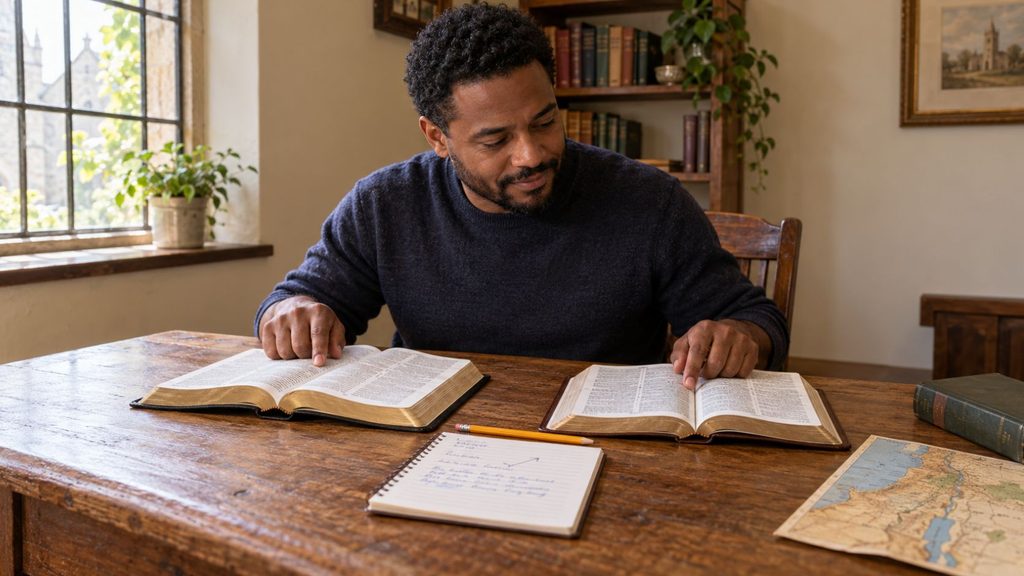
Reading moves through the text. Study stops and asks questions of it.
When you study, you start understanding why God established covenants with Noah, Abraham, Israel through Moses, and King David. You also see how these covenants connect and eventually lead to the coming of the Messiah.
That gives us more clarity when reading a verse like this:
“concerning his Son, Jesus Christ our Lord, who was a descendant of David according to the flesh”
—Romans 1:3 (CSB)
If you are normally reading from one page to another, you may understand that Jesus descended from D