
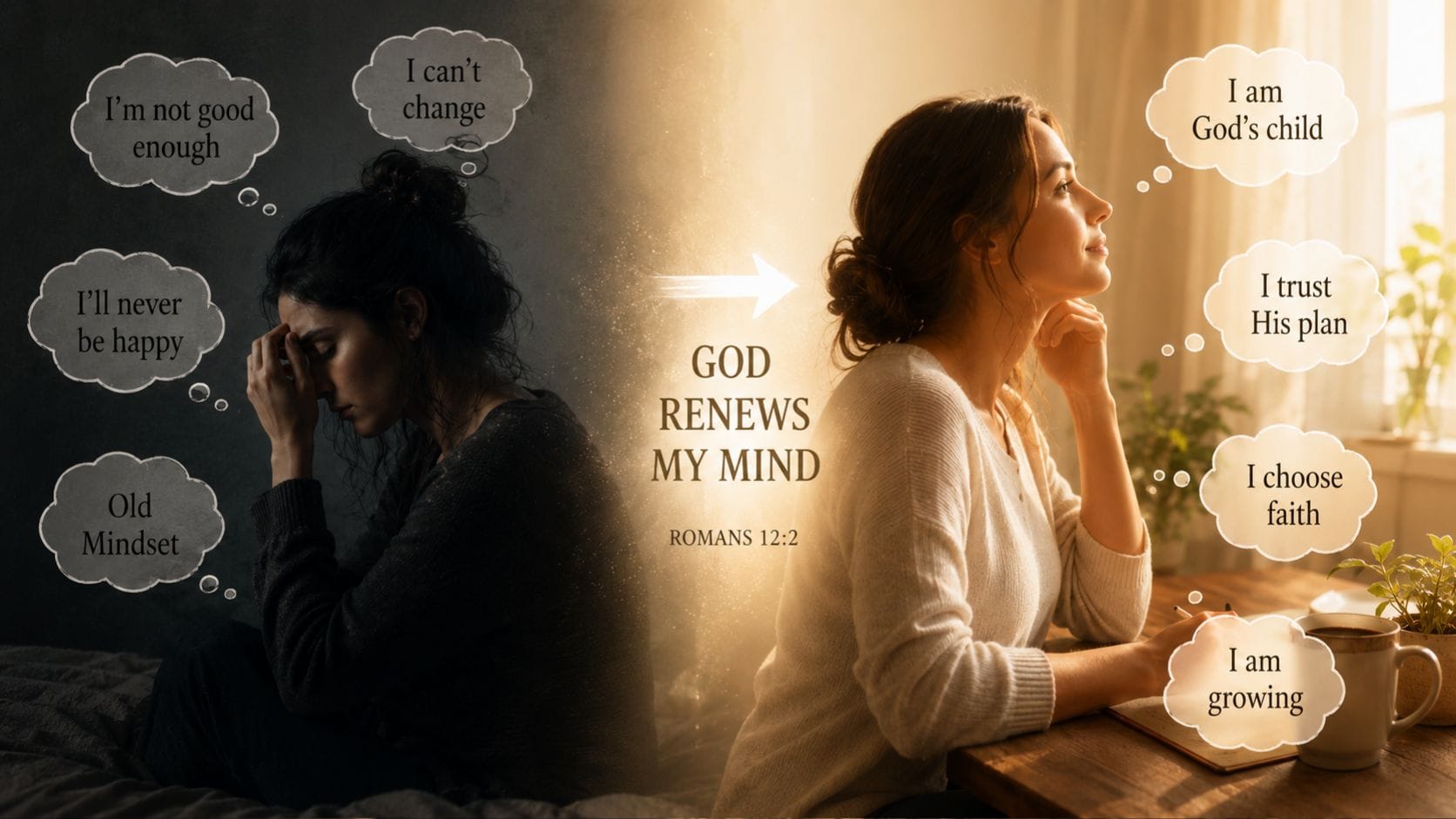
How to Renew Your Mind According to the Bible
Can Jesus really change the way we think, desire, and see the world?
Over the years, I’ve seen God transform people in beautiful ways, completely renewing their minds when it comes to desires, interests, priorities, and much more.
A few months ago, I participated in a small evangelistic work in my city. I met a young guy from the USA who joined us to work side by side.
He had lost his mother as a teenager and later became deeply involved in the LGBT community. Somewhere along the way, Jesus saved him.
According to his testimony, Jesus changed him deeply, including his sexual desires. He told me he now wanted to get married and build a family.
Stories like that bring tears to my eyes. They bring me closer to God and make me want to share the gospel with even more people. Truly, there is no one like Jesus.
But what does it actually mean for God to renew your mind?
In this guide, we’ll check what Scripture teaches about renewing the mind, how our thoughts and desires begin to change, and what that transformation can look like in everyday Christian life.
Key Takeaways
- Renewing your mind is more than positive thinking. God gradually changes the way you see yourself, other people, sin, suffering, and the world around you.
- Be careful what shapes your mind. Social media, entertainment, culture, and even Christian teachers can influence your thinking more than you realize.
- Do not automatically believe every thought you have. Learn to stop, question repeated patterns, and ask whether they actually align with what God has revealed.
- Use Scripture to correct false thinking. Identify the thought, find relevant Bible passages, read them in context, and bring them into your prayer life.
- Be patient with the process. Renewal does not normally happen overnight. Sometimes growth simply means noticing an unhealthy pattern sooner and responding differently than you did before.
What Does “Renewing Your Mind” Mean in Romans 12:2?
Paul writes:
“Do not be conformed to this age, but be transformed by the renewing of your mind, so that you may discern what is the good, pleasing, and perfect will of God.”
—Romans 12:2, CSB
I’d love more people to understand what renewing your mind means.
I’ve noticed this when I talk about Jesus with some people. They often think it’s just following a bunch of man-made rituals and rules. You simply force yourself to be a nice guy.
But that is not the case.
God transforms us from the inside out. Scripture even describes those who are in Christ as a new creation.
Romans 12 Starts With Mercy, Not Self-Improvement
Just before talking about renewing our minds, Paul says:
“Therefore, brothers and sisters, in view of the mercies of God, I urge you to present your bodies as a living sacrifice, holy and pleasing to God; this is your true worship.”
—Romans 12:1, CSB
We can see what Paul says previously: “in view of the mercies of God.”

God first shows us mercy, and we respond by offering ourselves to Him. In other words, we surrender our lives to God and cooperate with His grace.
That does not mean our choices and effort suddenly do not matter. But Christianity is not simply us trying harder to follow a set of rules through willpower alone.
Yes, initially it can feel hard to give up certain bad habits, addictions, or sins. But at the same time, God begins showing us that some of those things are wrong or harmful.
So, God gradually transforms our desires, changes our perspectives, and can also bring healing into areas of our lives. The things we once considered right may no longer look that way.
For instance, someone who used to be involved in the occult may begin looking at those practices completely differently after months of God working in their life. Things they once enjoyed may even start to repel them.
That is also where discernment begins to grow.
As Paul says in Romans 12:2, the renewing of our minds helps us discern “the good, pleasing, and perfect will of God.”
We slowly begin seeing more clearly what aligns with God and what does not.
The World Shapes Your Thinking Without Asking Permission
Over the past few years, the Western world has fallen into more depravity. And social media certainly has not helped.
Most platforms today run on algorithms that learn from what we watch and interact with, then keep feeding us more of the same or similar content.
In some instances, that may be good. In others, not so good.
For example, if you watch Christian videos from someone reputable, you may start getting more quality Christian content every day.

But let’s say you watch someone sharing a false gospel, and you’re a new Christian. I mean, you do not know any better.
This false preacher sounds credible, and he is charismatic.
The next day, you go to your feed and start seeing more videos from him or people teaching similar things. You keep watching, and after a few months, you may end up with a distorted view of the gospel.
The same thing applies to almost everything: relationships, fears, ambitions, money, politics, sexuality, and much more.
Your mind is like a garden
You need to be wise with the seeds you plant.
If you constantly plant seeds of fear, then weeds of fear will eventually start growing in your garden. What we continually put into our minds shapes how we think, and our thoughts eventually affect how we behave.
The opposite is also true.

If you plant good seeds, keep reading the Bible, and listen to reputable Christian teaching, those things begin shaping your mind too.
Over time, you may become more compassionate, loving, courageous, and more aligned with God’s way of seeing things.
Paul says:
“Finally brothers and sisters, whatever is true, whatever is honorable, whatever is just, whatever is pure, whatever is lovely, whatever is commendable—if there is any moral excellence and if there is anything praiseworthy—dwell on these things.”
—Philippians 4:8, CSB
So, we need to be careful about what we continually watch and listen to through social media, TV series, news, music, and everything else.
That does not mean hiding from the world or only consuming Christian content.
But if we constantly feed our minds darkness, we shouldn’t be surprised when some of that darkness starts influencing how we think.
Renewing our minds also means becoming more intentional about what we allow to shape them.
A Renewed Mind Learns to Question Its First Interpretation
What do you start noticing?
I remember that around a year into my journey, I started noticing patterns in my thoughts.
For some reason, every Wednesday afternoon, I became a doomer. I suddenly felt depressed out of nowhere, but I started paying attention to what was going through my mind:
- “You are not worthy.”
- “You suck.”
- “You this and that…”
I’m still not sure why I was having those thoughts. It could have been spiritual warfare, or there could have been other reasons. But I prayed and asked God to help me.
With time, that pattern disappeared. Nowadays, it no longer happens.

So, as our minds are renewed, we can also grow in discernment. We start noticing patterns in our thoughts and lives that require attention.
Instead of immediately accepting every thought that enters our minds, we can stop and ask:
“Is this actually true? Is this how God sees me? Does this line up with what God has revealed?”
For example:
- “If I fail, I am worthless.”
- “If people disagree with me, they are against me.”
- “If God loved me, this would have worked out.”
- “If I feel strongly about something, it must be true.”
- “If everyone accepts it, it cannot be wrong.”
At the same time, we should not become obsessive and analyze every thought that enters our minds.
But yes, when we notice a repeated pattern that affects our behavior or mood, or clearly does not line up with God’s truth, then it is worth paying attention to and working on.
The point is not obsessive thought-monitoring but growing discernment.
A Simple Exercise to Challenge Your Thought Patterns
I want to share a simple but powerful exercise I did back then that helped me. I guess all my years of studying self-help before still gave me some worthy tools that I could apply to my Christian walk.
1. Grab a Notepad
Get a small notepad.
Something you can carry with you throughout the day in your pocket.
2. Pay Attention for the Next Seven Days
Throughout the week, write down thought patterns you start noticing.
What are you thinking on Monday, Tuesday… and the rest of the week?
The purpose is to bring things into the light that you may normally not notice.

For example:
- “I’m constantly thinking that I’m worthless.”
- “I think God does not love me because I did many wrong things in the past.”
- “I do not believe I can overcome my current struggles.”
Sometimes, you may not have a clear thought. Instead, you may notice an emotion that keeps appearing in certain situations.
Write that down too.
Ask yourself:
What happened? What was I thinking when I started feeling this way?
For example:
Someone told me something I did not like. I did not reply, and afterward I felt bad.
You are basically trying to notice patterns rather than letting them pass unnoticed every day.
3. After Seven Days, Compare the Patterns With Scripture
After seven days, you should have a decent list of things written down.
Now what?
Let’s say one of the most common thoughts was:
“I think God does not love me because I did many wrong things in the past.”

Now you want to test that belief against Scripture.
You want to base yourself on the Word of God. Truth is one of the best ways to correct false thinking.
If you want, you can use ChatGPT, Claude, Perplexity, or Gemini to help you find relevant passages.
For example, you could ask:
“I keep believing that God does not love me because of things I did in the past. Give me five Bible passages that address this belief. Explain the context of each passage and what it actually teaches.”
But do not simply copy whatever an AI gives you and call it a day.
Open your Bible and read those passages in context.
You can also use a Bible search website such as BibleGateway, although that may take a bit more work.
The goal is not to find random comforting verses. You want passages that actually speak to the belief you are struggling with.
4. Read the Passages And Pray
Now, when you pray, read those passages and ask God:
“Please, God, renew my mind concerning these thoughts. Help me see what is false and let Your Word become the truth I stand on. In the name of Jesus, amen.”
Spend some time meditating on those passages.

When the old thought comes back, return to what Scripture actually says.
Over time, you may notice that the thought appears less often. Or maybe it still appears, but you catch it much faster and no longer automatically believe it.
Then you can repeat the same exercise with another pattern.
I found this a powerful way to challenge my own thinking with the Word of God.
Renewal Does Not Happen Overnight
Coming from nearly two decades of self-help, I used to be the type of guy who spent hours writing down positive affirmations, trying to force myself to change certain negative thoughts.
None of that seemed to have a major impact on me.
In a few years, God changed me more than all those years before. I praise and thank God every single day for His continuous work in my life and in those around me.
That said, I believe God can work deeply in you too, as long as you remain open to Him and willing to change.
Also, change is not always the most pleasant thing. We often prefer to stick to our comfort zone. But sometimes growth requires us to leave things behind that feel familiar and comfortable.

Even though this is not a biblical passage, I still love this phrase often attributed to André Gide:
“Man cannot discover new oceans unless he has the courage to lose sight of the shore.”
So, let God work in your life, and be patient with yourself.
Do not expect an overnight change. Instead, you may slowly start noticing little things changing.
Maybe you no longer get as mad or reactive in a specific situation as you did before.
That’s small, but it is still something.
This is also why I wrote about signs of spiritual growth. Sometimes God has already changed us more than we realize because we look for something dramatic instead of noticing the smaller changes.
Not Every Thought Defines You
Also, not every unwanted thought means you have sinned, or that thought represents who you are.
This last week, I have been having many weird and, honestly, ungodly dreams.
Even though I have those dreams, I do not give them power. I set them aside and tell myself, “Nope. This is not what God thinks about me.”
Scripture says:
“Your word is a lamp for my feet and a light on my path.”
—Psalm 119:105, CSB
So, renewing our minds is a continuous process of correcting old thinking patterns, changing habits, and growing closer to the way God wants us to think.
It is not exactly something that happens overnight.
Last Thoughts
God may already be changing the way you think more than you realize. So, what is one thought pattern you believe God is asking you to work on right now?
I’d love to hear your experience in the comments. And if God has already renewed your mind in a specific area, share that too. Your story may encourage someone else.