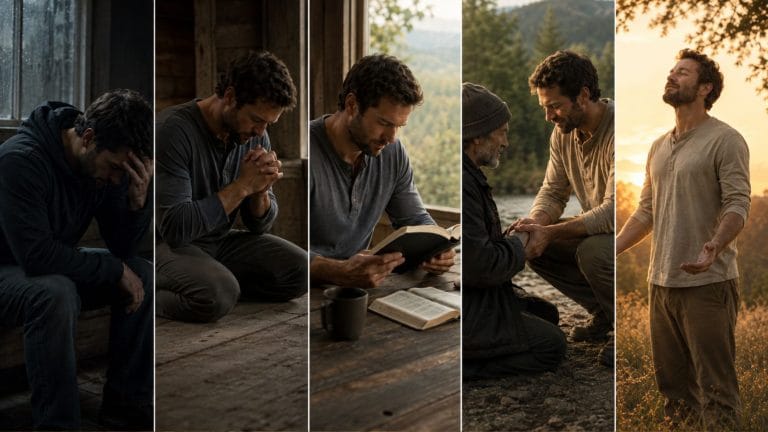

How to Pray When You Don’t Know What to Say: 6 Easy Steps
Have you ever sat down to pray and realized you had no idea what to say?
Honestly, this is not a problem I usually face. Before becoming a Christian, I practiced mindfulness meditation. I no longer practice that kind of meditation, but it taught me to remain quiet for long periods.
I still do that today, especially in the morning when I wake up feeling drowsy. Sometimes, I simply remain quiet before God. Over the years, I have also learned to speak with Him more honestly.
Still, I understand why prayer can feel difficult. In some church settings, people seem to pray perfect, polished prayers. Hearing them may give you performance anxiety.
Like you need special words before God will listen.
Grief, shame, exhaustion, distraction, or dryness can make the words even harder to find.
In this guide, I’ll explain how to pray when you don’t know what to say. You do not need to invent an impressive prayer. Scripture gives us words, Jesus gave us the Lord’s Prayer, and the Holy Spirit helps us in our weakness.
Key Takeaways
- You do not need perfect words to pray. Sometimes, the most honest prayer is simply, “God, I do not know what to say, but I am turning toward You.”
- The Holy Spirit helps us in our weakness. Romans 8:26 reminds us that God understands what we cannot explain properly.
- You do not have to invent every prayer. Use the Lord’s Prayer, the Psalms, written prayers, or a Bible passage when your own words are not coming.
- Prayer does not need to sound impressive. Thank God, confess honestly, pray for others, sit quietly, or ask for help. God is not grading your vocabulary.
- Do not wait until you feel spiritually ready. Come to God while you are tired, confused, ashamed, or distracted. The right moment to begin praying is today.
Why You May Be Struggling to Find the Words
There are several reasons you may struggle to find words during prayer. I’ll name a few, and you can see which one best fits your situation.

You Are New to Christian Prayer
Maybe you are new at this and wonder, “What should I say? If I say this or that, will God still love me? Do I need some special words or secret formula before He will listen?”
That is normal. But God is not waiting for you to produce the perfect prayer. Jesus said that our Father already knows what we need before we ask Him.
You Feel Emotionally Overwhelmed or Numb
At certain times in life, we may feel emotionally overwhelmed or completely numb. This can happen after something painful or traumatic, such as losing someone we love.
You may want to pray but not know how to explain what is happening inside you. Perhaps you do not even fully understand it yourself.
You do not need to name every emotion perfectly before turning toward God.
You Feel Ashamed Before God
God has seen everything throughout the ages. I sometimes wonder how He still has patience with us.
There is nothing you have done that He has not seen. He knows your heart, your motives, and everything else. Knowing that, we should approach Him honestly rather than trying to hide.
“The eyes of the Lord are everywhere, observing the wicked and the good.”
—Proverbs 15:3, CSB
You Are Experiencing Spiritual Dryness
Our journey with God has its ups and downs.
Sometimes, we feel His presence so closely during prayer that it seems we can nearly touch Him. At other times, we wonder what happened. Does God still listen? Why do we no longer feel the way we once did?

Such seasons can happen even to faithful Christians. Feeling that God is distant does not necessarily mean He has abandoned us.
You Are Distracted
One common distraction is our mobile phone. You may be praying when a notification from social media appears, and suddenly you feel the need to check it.
Other distractions come from events in our lives. Perhaps you argued with someone earlier. Later, when you begin praying, you replay the entire conversation in your head. It feels as though it is stuck there, taking up all the space where your prayer was supposed to be.
What Romans 8:26 Means When You Cannot Pray
The fantastic thing is that God already knows what we need. In fact, Jesus said that our Father knows our needs before we even ask Him.

Paul writes:
“The Spirit also helps us in our weakness … the Spirit himself intercedes for us with inexpressible groanings.”
—Romans 8:26, CSB
The Holy Spirit helps us in our weakness. This passage openly admits that sometimes we do not know what to pray for as we should.
So, when you cannot find the right words, for example tell God:
“God, I do not know what to say. I lost my friend in a car accident. Please help me.”
You do not need to explain everything perfectly. God knows our hearts, and the next verse says that the Spirit intercedes for us according to God’s will.
We can rest in God, knowing that we are not carrying our burdens alone. He may not remove every problem immediately, but He helps us in our weakness.
At the same time, stay grounded. The “inexpressible groanings” in this passage refer to the Spirit’s intercession. They do not mean that every emotion, groan, or inner impression is a message from God. Our confidence rests in the Spirit’s help and God’s will, not in our ability to interpret every feeling.
You Do Not Have to Invent Every Prayer
We tend to complicate things. I mean, come on, we are human. Humans are complicated, after all.
But we do not need to reinvent the wheel here. God has already given us some good ways to pray.

The Lord’s Prayer
Jesus gave us a powerful prayer that touches on our relationship with God and many of our daily needs:
- Honoring God’s name and seeking His kingdom.
- Asking for daily spiritual and physical provision.
- Asking for forgiveness while also forgiving others.
- Asking for help against temptation.
- Recognizing that we need God to deliver us from evil.
For a long time, I did not pay much attention to this prayer. Mostly because my church at the time did not emphasize it.
Later, I read the Didache. It is a short guide that gives us a glimpse into the practices of early Christians. It tells believers to pray the Lord’s Prayer three times a day. From there, I started doing the same. I treat this more as helpful guidance than a strict rule you must follow.
The Psalms
I learned this partly from Pastor Derek Prince. He encouraged Christians to read the Psalms aloud and use their words as prayer.
The Psalms touch nearly every part of human experience: praise, repentance, injustice, fear, spiritual dryness, disappointment, and trust. Some are peaceful. Others sound like the writer is barely holding himself together.
Begin reading through them and notice which ones reflect what you are experiencing. When you cannot find your own words, you may find that a psalmist has already said what is in your heart.
Memorize Prayers and Bible Passages
It can also be helpful to memorize short prayers and passages from Scripture.
Sometimes, you may not have your Bible nearby. Or perhaps you simply feel too lazy to open it. A memorized passage can then become your prayer.
For instance, one verse that comes to my mind when I feel spiritually attacked is:
“No weapon formed against you will succeed.”
—Isaiah 54:17, CSB
This does not mean that Christians will never suffer or that nothing bad can happen to us. But it reminds me that the enemy does not have the final victory. God is still in control, even when I cannot see what He is doing.
You can do the same with passages about fear, repentance, grief, temptation, or trusting God. You do not need to invent an original prayer every time. Sometimes, you can simply pray the words God has already given us.
How Do You Pray When You Don’t Know What to Say?
I’m not saying that I pray perfectly, but this is what I do.
I usually pray first thing in the morning and before going to bed. This is more of an example of my night prayer routine, which normally lasts around 30 to 45 minutes. Of course, you can shorten it or change things depending on your time and preferences.
1. The Lord’s Prayer
I start with the Lord’s Prayer. I try my best not to say it mindlessly. Instead, I pause at each line and meditate on its words.

2. Thankfulness and Gratitude
I focus on my day and thank God. These can be little things. For example:
- If you had the opportunity to share a meal with your loved ones.
- If you have good health, food on your table, or a place to sleep.
We have so many things to be grateful for. We tend to look at what we lack. By doing this, we start looking at what we already have.
It can slowly change the way we look at our day.
3. Intercession
I sometimes have a list of people I want to pray for. Still, I commonly pray for:
- My church leaders and their ministry.
- Friends and family members.
- My city and country.
When I do not know whom to pray for, I ask the Holy Spirit to help me. Sometimes, a person’s name comes to mind.
I do not automatically assume that this is the Holy Spirit speaking directly to me. But I can still pray for that person.
4. Personal Prayer and Repentance
I ask God for protection, humility, more faith and hope, and a loving heart. It really depends on the season.

But I think the thing I pray most often is:
“God, please remove any pride from my heart.”
I then look back at my day and see whether there is anything I need to repent of and ask forgiveness for.
If it involves a serious sin, I also bring it to confession. It may also help to speak with someone you trust, such as a Christian friend or church leader.
5. Staying in Silence
One thing I have noticed over the years is that many people struggle with this last part.
Our lives have become such a rollercoaster of emotions and activity. We tend to forget what it feels like simply to sit in silence. I know this is not easy for everyone, which is why I think we should work on it.
Silence can help us become more attentive to God. I mean, when you talk nonstop, you may not leave much room to listen or notice what is happening inside you. Christian contemplative prayer has long included silence and attention toward God.
So, I like to spend the last few minutes of prayer in silence. At times, when I have an important matter, I may ask God:
“Lord God, what should I do in this situation?”
God may answer us in different ways. Sometimes, I leave prayer with a deep inner sense of what I should do. Other times, I go to church the next day, and the preacher talks about exactly what I needed to hear.
Still, I remind myself that not every feeling, thought, or coincidence is God speaking. I need to test it against Scripture, Church teaching, and wise advice from other Christians.
Sometimes, no clear answer comes. In those moments, I simply remain with God.
6. Ending With Scripture
I may open my Bible and read a few passages from Scripture. I particularly enjoy reading something connected to Jesus. For instance:

- His birth.
- His baptism.
- His first miracle.
- The Garden of Gethsemane.
- His resurrection.
You can choose the passage before you begin praying so that it is easy to find. Read it and ask:
“What does this show me about Jesus?”
For example, Jesus was suffering in the Garden of Gethsemane. He asked the Father whether the cup could pass from Him, but He still submitted to His will:
“Yet not as I will, but as you will.”
—Matthew 26:39, CSB
This teaches us to trust God even when His plan is difficult. I then ask God to strengthen my faith and help me trust Him more, as Jesus did in Gethsemane.
I end by thanking God for being present with me.
A Final Note
I tend to change one thing or another from day to day. You can do the same so that everything does not become repetitive. But most nights, I do something along those lines.
Also, you do not need to do all of this in a single prayer session. You can choose one thing or another and adjust it depending on the day.
For instance, one day you may begin by thanking God and then spend a few minutes praying for someone. The next day, you may begin by reading Scripture and meditating on it.
Do Not Wait for the Perfect Moment to Pray
You do not need to be perfect before coming to God. So, the perfect moment to start praying is today.
You may not know the right words, and some things you read here may still feel complicated. Still, come to God as you are.
I remember when I started. I was a mess. I mean, a serious mess.
I had just gotten out of a toxic relationship. I was not well spiritually or mentally. Still, I made an effort to come to God every day. Sometimes, I just sat for hours in silence. Other times, I shared my burdens with Him.
I was far from perfect or having the right things to say. But I showed up day after day, no matter what.

Since then, God has transformed my heart and filled me with more peace and joy than I had ever experienced before. I can truly say that I did not know this kind of peace and love until I came to know our Lord Jesus.
Jesus said:
“Come to me, all of you who are weary and burdened, and I will give you rest. Take my yoke upon you and learn from me, because I am lowly and humble in heart, and you will find rest for your souls. For my yoke is easy and my burden is light.”
—Matthew 11:28–30, CSB
You do not need to wait until you feel peaceful, focused, or spiritually prepared. You can begin while you are still tired, confused, and unsure of what to say.
Last Thoughts
Do you struggle to find the right words when you pray? Do you feel overwhelmed, ashamed, distracted, or simply unsure how to begin?
Leave your experience or question in the comments below. I’ll read it and try to help where I can.
Also, share this post with someone who may be struggling with prayer. It might be exactly what they need today.