What Is Christian Theology? A Simple Guide
What is theology? And do I need to become a theologian to defend my faith?
In some shape or form, everyone has a way of understanding reality. We all hold beliefs about God, humanity, right and wrong, and what happens after death.
As Christians, we want to see existence through the lens of what God has revealed.
Christian theology is about understanding who God is, what He has done, and how these truths connect and shape the way we live.
Honestly, when I first became a Christian, I did not enjoy reading the Bible.
It was not because I found the stories, poems, or teachings boring. I found it hard to understand and after a few minutes I was yawning. Sometimes months went by without me touching it.
Then I switched to listening to the Bible in audio. That changed everything. For some reason, I understand Scripture more easily when someone reads it aloud.
I started understanding the stories better and seeing connections I had never noticed before. Slowly, the Bible went from something I struggled to read into something I genuinely loved.
I also realized that Scripture is not only a collection of stories, poems, and commandments. It reveals who God is, what went wrong with humanity, why we need salvation, and how everything finds its fulfillment in Jesus Christ.
That is where theology begins.
You do not need a degree to follow Christ. But if you want to understand your faith, explain it clearly, and recognize false teaching, theology already matters to you.
Key Takeaways
- Every Christian already has a theology. We all believe something about God, Jesus, salvation, the Church, and eternal life. The goal is to make sure those beliefs are clear and truthful.
- Theology begins with God revealing Himself. We do not invent ideas about God from nothing. He makes Himself known through creation, Scripture, His actions in history, Jesus Christ, and the faith passed on through the Church.
- Good intentions do not guarantee good theology. We can sincerely believe something and still be wrong. That is why we should read Scripture carefully, study Church history, and avoid building beliefs around one experience or online teacher.
- Theology helps us connect the Bible. Biblical, systematic, historical, moral, and practical theology each help us understand a different part of the Christian faith and how everything fits together.
- You do not need to understand everything at once. Start with the central Christian story, study one doctrine at a time, learn the historic creeds, ask questions within the Church, and read reliable theology books.
Theology Begins With God Revealing Himself
The word theology comes from the Greek words theos, meaning “God,” and logia, meaning “discourse” or “reasoning.”
In simple terms, theology means studying and speaking about God.
Before I became a Christian, I thought religion was something men created to control humanity.
In some cases, religion can certainly be used that way, especially in cults. But everything Christians know about God did not come from a group of people sitting in a room and speculating about things out of nothing.
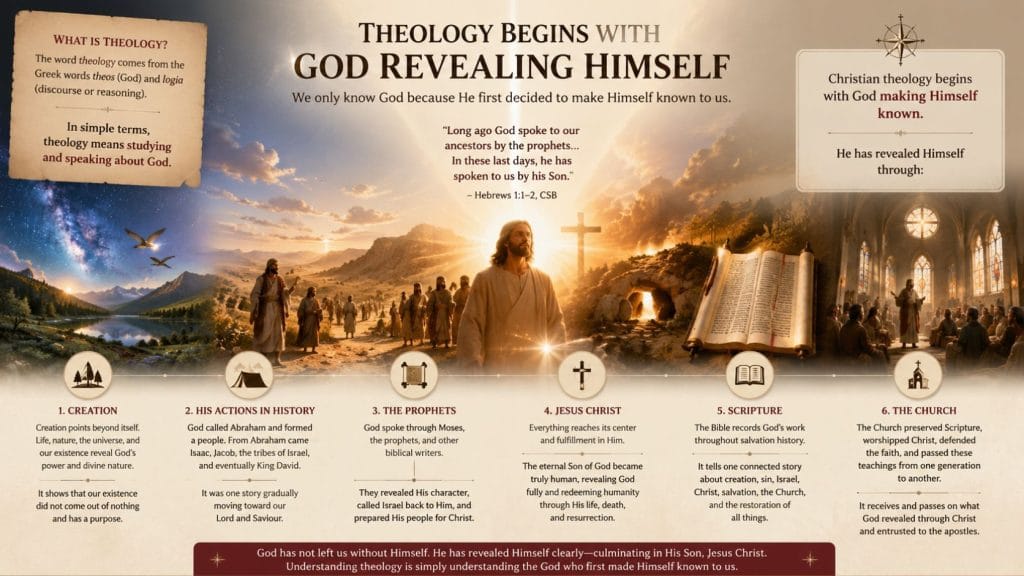
Christian theology begins with God making Himself known.
He has revealed Himself through:
Creation
We only need to look around to see that creation points beyond itself. Life, nature, the universe, and our own existence reveal something about God’s power and divine nature.
Creation does not tell us everything about God. But it clearly shows that our existence did not come out of nothing and has a purpose.
His actions in history
God called Abraham and formed a people through his descendants. From Abraham came Isaac, Jacob, the tribes of Israel, and eventually King David. Through this history, God prepared the way for Jesus Christ.
It was not a collection of random events. It was one story gradually moving toward our Lord and Saviour.
The prophets
God spoke through Moses, the prophets, and other biblical writers. They revealed His character, called Israel back to Him, and prepared His people for what He would accomplish through Christ.
Jesus Christ
Everything reaches its center and fulfillment in Him.
The eternal Son of God became truly human. Through His life, teachings, death, and resurrection, God revealed Himself more fully and carried out His plan to redeem humanity.
Scripture
The Bible records God’s work throughout salvation history. Despite being written across many generations and through different human authors, it tells one connected story about creation, sin, Israel, Christ, salvation, the Church, and the restoration of all things.
The worship and teaching life of the Church
Christians do not receive the faith as isolated individuals. From the apostles onward, the Church preserved Scripture, worshipped Christ, defended the faith, and passed these teachings from one generation to another.
The Church does not invent new revelation. It receives and passes on what God revealed through Christ and entrusted to the apostles.
Jesus stands at the centre of Christian theology because God has revealed Himself decisively through His Son:
“Long ago God spoke to our ancestors by the prophets… In these last days, he has spoken to us by his Son.”
—Hebrews 1:1–2, CSB
In other words, we only know God because He first decided to make Himself known to us.
Every Christian Already Has a Theology
Often, we imagine that a theologian must be a church leader, an academic, or someone like St. Thomas Aquinas, one of the most influential theologians in Christian history.
But theology is present whenever someone says:
- “God is loving.”
- “Jesus died for our sins.”
- “The Bible is God’s Word.”
- “The Holy Spirit lives in believers.”
- “God forgives those who repent.”
- “Christians will be raised from the dead.”
These are all theological claims.
So, when people say that “every Christian is a theologian,” it simply means that we already think and speak about God.
It does not mean that everyone’s theology is perfect or that every opinion about God is equally true.
Good Intentions Do Not Guarantee Good Theology
A person may sincerely believe something about God and still be mistaken.
Poor theology can come from:
- Misreading a Bible verse.
- Repeating something heard online.
- Allowing personal experiences to define God.
- Confusing cultural values with Christian truth.
- Building an entire belief around one emotional experience.
That is why we should continue working on our theology.
When we teach a new Christian, speak with someone who does not believe, or explain the gospel to a child, we want to present the faith as simply and accurately as possible.
Simple does not have to mean incomplete.
Refusing Theology Does Not Remove Theology
You may say:
“Yeah, but I do not need theology. I just want to follow Jesus.”
Well, following Jesus also means understanding who He is, what He taught, and what Scripture reveals about Him.
Both things go hand in hand.
I have noticed that the more I understand the Bible, the more I learn to love God. Theology does not replace our relationship with Him. It helps us better understand the God we already worship.
Part of loving God is wanting other people to know Him too. Learning how to explain His Word simply may help someone else understand the faith.
This means we should know at least the basics:
- Who is Jesus?
- Which teachings truly come from Him?
- What did His death accomplish?
- How should His words be understood?
- What authority did He give to His apostles?
- What does that authority mean for the Church today?
The Christian faith did not begin with us.
We received Scripture, the teachings of the apostles, and the faith because the Church passed them from one generation to another.
Rejecting formal theology does not make us theology-free. It often leaves us with beliefs we have never properly examined.
We do not need to understand everything. But we should know enough to understand the Jesus we follow and explain why we follow Him.
Where Does Christian Theology Come From?
Christian theology begins with God revealing Himself. But understanding and explaining what He has revealed involves several things.
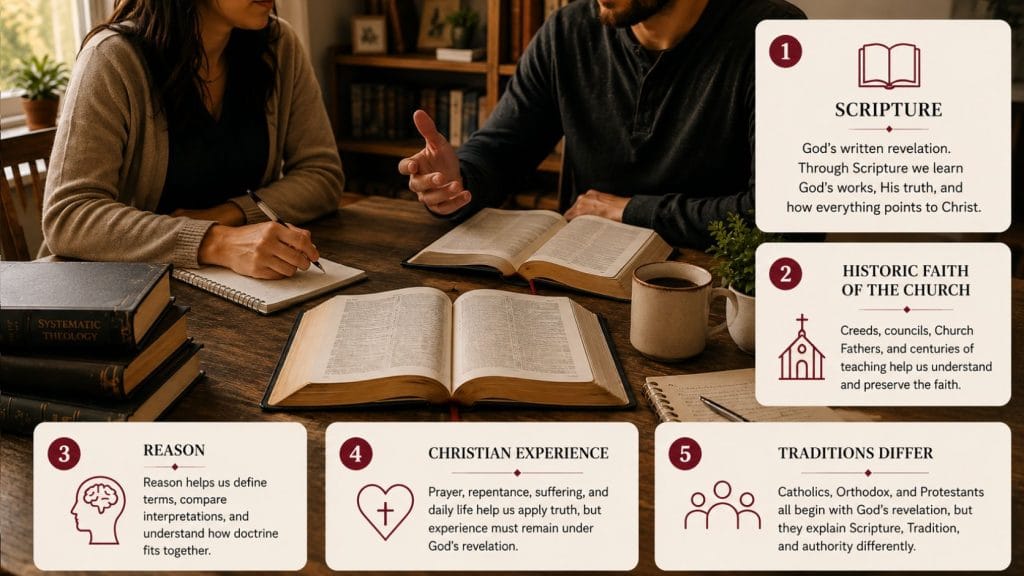
Scripture
Scripture is central to Christian theology.
Through it, we learn what God has done throughout salvation history, what the prophets and apostles taught, and how everything reaches its fulfillment in Jesus Christ.
Theology should not be built around our imagination or personal opinions. It must remain rooted in what God has revealed. Scripture itself should also be read carefully, considering the passage, the author, and the wider message of the Bible.
The Historic Faith of the Church
As I started studying Christian history more deeply, I came to one realization.
We should not ignore it.
I know not everyone will like what I am about to say, but in my experience, some low-church communities do a poor job of teaching Church history. It can almost feel as though Christianity disappeared after the apostles and returned centuries later.
We should study the historic creeds, councils, Church Fathers, catechisms, and centuries of Christian teaching.
They do not replace Scripture. But they help us understand how earlier Christians interpreted, defended, and passed on the faith, especially teachings such as the Trinity and who Jesus Christ truly is.
Reason
Theology also requires careful reasoning. Scripture was written in ancient languages and cultures. People sometimes expressed themselves differently from how we do today.
So, we need to consider the context, writing style, original audience, and meaning of the words.
Reason helps us:
- Define terms.
- Recognize contradictions.
- Compare interpretations.
- Respond to objections.
- Understand how doctrines connect.
We should not use our reasoning to stand above Scripture. Instead, we use it to understand and explain God’s revelation more clearly.
Reason does not create revelation. But it helps us understand it. Faith and reason should work together because truth cannot contradict truth.
Christian Experience
At the same time, theology should not become only an intellectual exercise. Otherwise, the Bible may begin to feel like another philosophy book.
Our experiences with prayer, suffering, repentance, answered prayers, and walking with God can help us see how Christian truth applies to real life.
However, our feelings, dreams, impressions, or experiences should never become the final authority.
We can misunderstand what happened. We may also interpret an experience according to what we already want to believe.
Our experiences should be understood through God’s revelation. They should not be used to redefine who God is.
Christian Traditions Do Not Explain This in the Same Way
Christians agree that theology begins with God revealing Himself. However, Catholics, Orthodox Christians, and Protestants differ over how Scripture, apostolic Tradition, and Church authority work together.
Catholic theology understands Scripture, Tradition, and the teaching authority of the Church as closely connected. Orthodox Christianity also reads Scripture within Holy Tradition, while Protestant traditions generally treat Scripture as the only infallible rule of faith.
The Main Areas of Christian Theology
Christian theology has several areas of study. Each one approaches the faith from a slightly different direction.
Here are five of the main ones.
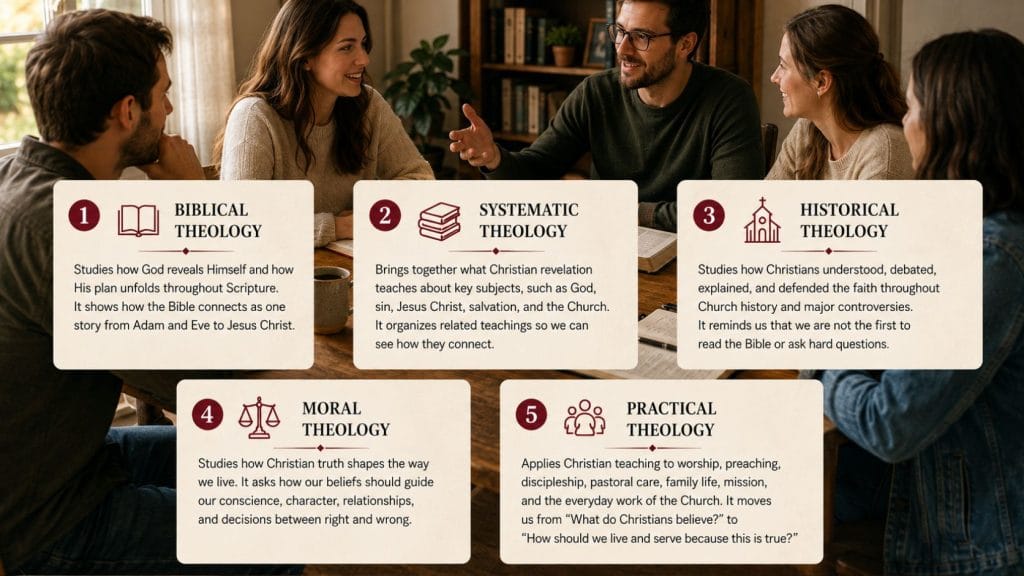
Biblical Theology
Biblical theology studies how God reveals Himself and how His plan unfolds throughout Scripture.
It helps us see how the Bible connects as one story from Adam and Eve to Jesus Christ.
For example, it may trace themes such as covenant, sacrifice, kingdom, temple, and resurrection from Genesis to Revelation.
Systematic Theology
Systematic theology brings together what Christian revelation teaches about a particular subject.
For example:
- Who is God?
- What is sin?
- Who is Jesus Christ?
- What does salvation mean?
- What is the Church?
The Bible is not always an easy book to understand. Systematic theology organizes related teachings so we can see how they connect rather than leaving them as separate verses and stories.
Historical Theology
Historical theology studies how Christians understood, debated, explained, and defended the faith throughout Church history.
It helps answer questions such as:
- How did the first Christians understand Communion?
- Why was the Nicene Creed written?
- How was the biblical canon recognized?
- How did Christian teaching develop during major controversies?
This reminds us that we are not the first people to read the Bible or ask difficult theological questions.
Moral Theology
Moral theology studies how Christian truth shapes the way we live.
It asks how our beliefs should guide our conscience, character, relationships, and decisions between right and wrong.
In simple terms, it asks:
What difference should following Jesus make in the way I live?
Practical Theology
Practical theology is probably the area many Christians encounter most often.
It applies Christian teaching to worship, preaching, discipleship, pastoral care, family life, mission, and the everyday work of the Church.
It helps us move from:
“What do Christians believe?”
to:
“How should we live and serve because this is true?
How Can an Ordinary Christian Begin Studying Theology?
Like many people, I started by thinking that reading the Bible from cover to cover was the best way to understand it.
You can certainly do that. It is not wrong.
But you may reach the end and still struggle to understand how everything connects. Why did humanity fall? Why did God make covenants with His people? Why did He need to send Jesus?
Most Bibles are also not arranged in strict chronological order. At one point, you are reading about the rise of King David in Samuel. Later, Chronicles takes you back through much of Israel’s history again, with a particular focus on David, Judah, and the temple.
It can quickly become confusing to connect all the dots.
So, here are a few strategies that may help you begin studying theology.
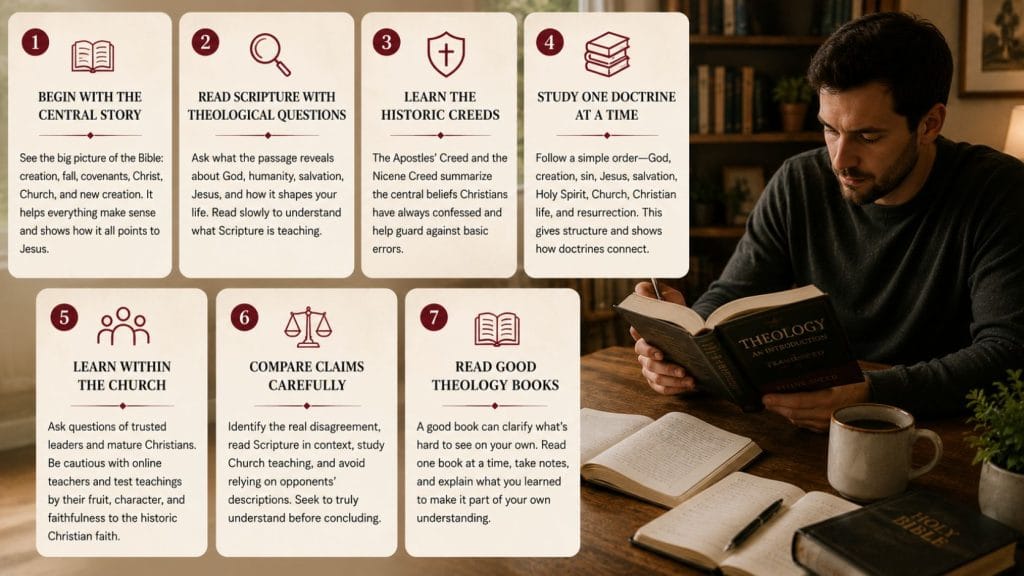
1. Begin With the Central Christian Story
First, you want to understand the full picture.
Imagine having a bird’s-eye view of the Bible. You would see something like this:
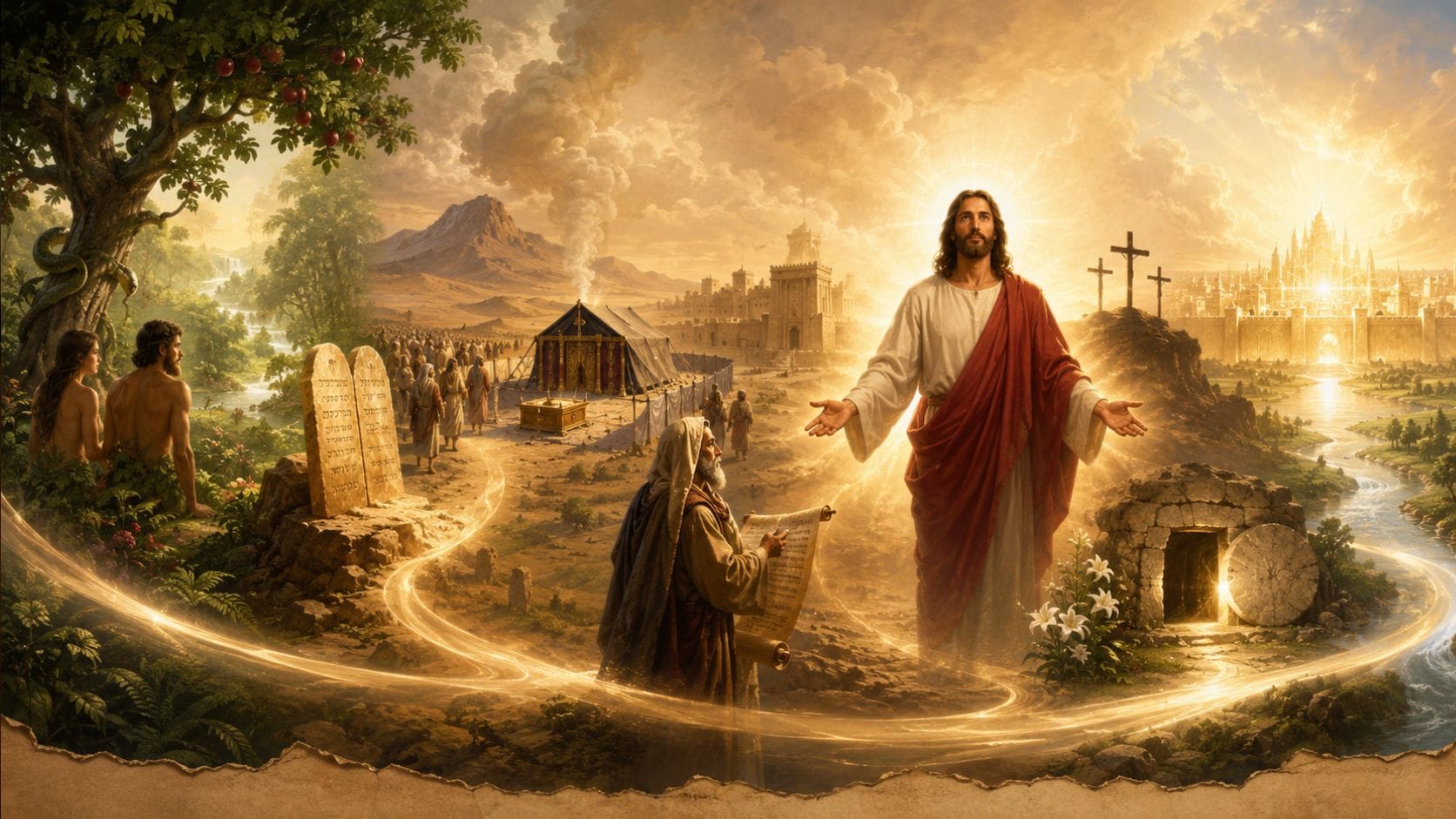
Creation → fall → covenants → Christ → Church → resurrection and new creation
Once you understand this basic movement, it becomes easier to see why certain events happened and how they connect.
Adam’s sin, God’s promises to Israel, the sacrifices, the prophets, and the coming of Jesus are not separate stories. They are parts of one larger story that reaches its fulfillment in Christ.
Paul even calls Jesus the “last Adam,” showing the connection between humanity’s fall through Adam and the new life that comes through Christ.
2. Read Scripture With Theological Questions
When you read Scripture, slow down and ask what the passage is teaching.
For example:
“For God loved the world in this way: He gave his one and only Son, so that everyone who believes in him will not perish but have eternal life.”
—John 3:16, CSB
Now ask:
What does this reveal about God?
God loves the world and gave His Son for our salvation.
What does it reveal about humanity?
Humanity is in danger of perishing and needs to be saved.
What does it teach about salvation?
Eternal life comes through faith in Jesus Christ.
What does it reveal about Jesus?
He is God’s one and only Son, sent into the world by the Father.
How should this shape my life?
I should place my faith in Jesus and follow Him.
You do not need to ask every question each time. The point is to read slowly enough to understand what the passage reveals about God, humanity, salvation, and Christian life.
3. Learn the Historic Creeds
Begin with the Apostles’ Creed and the Nicene Creed.
They do not replace Scripture. Instead, they summarize the central beliefs Christians have confessed throughout history.
They give you a basic map of Christian teaching about God the Father, Jesus Christ, the Holy Spirit, the Church, forgiveness, resurrection, and eternal life.
They can also help protect you from basic errors about who Jesus is or what Christians believe about the Trinity. The Catechism describes the Apostles’ Creed as a faithful summary of the apostles’ faith and the Nicene Creed as a more detailed explanation of that same faith.
4. Study One Doctrine at a Time
The Bible can feel overwhelming. We could study it throughout our whole lives and still have more to learn.
Instead of trying to understand everything at once, choose one doctrine at a time.

A simple order could be:
- Scripture and revelation.
- God and the Trinity.
- Creation and humanity.
- Sin.
- Jesus Christ.
- Salvation.
- The Holy Spirit.
- The Church.
- Christian life.
- Resurrection and eternal life.
This gives you a structure. Once you understand one doctrine, it becomes easier to see how it connects with the others.
5. Learn Within the Church
Ask questions of priests, pastors, teachers, and mature Christians.
We should also be careful about learning theology mainly through social media. There are trustworthy Christian teachers online. But there are also people making extraordinary claims without accountability.
Recently, a woman claiming to be an apostle appeared on my Instagram feed. In several videos, she moved her hand toward people, and they fell or began rolling on the ground before her.
After watching more of her content, I became convinced that these were false spiritual practices rather than the work of the Holy Spirit. The focus seemed to be on her apparent power and the dramatic manifestations surrounding her ministry.
This is why we should be careful about learning theology mainly through social media.
A large audience, television appearances, or supernatural-looking experiences do not prove that God is leading someone. We must examine the person’s teaching, character, fruit, and relationship with the historic Christian faith.
6. Compare Claims Carefully
Do not blindly follow everything you hear.
Some unhealthy Christian communities discourage questions, treat their leader as though they cannot be corrected, or teach that their group is the only one that truly understands God.
Over time, wrong teachings can be passed from one person to another until nobody questions them anymore.
Nowadays, I am far more critical of the claims I hear.
Several times, someone has taught me something confidently. After arriving home, I searched several sources and discovered that the claim was either inaccurate or far more complicated than they made it sound.
Now imagine never questioning anything.
After a few years, we may begin treating many unexamined ideas as truth.
When Christians disagree:
- Identify the actual disagreement.
- Read the biblical passages in context.
- Study how earlier Christians understood the question.
- Consult official Church or denominational sources.
- Avoid relying only on opponents describing one another.
The goal is not to become suspicious of everyone. It is to understand what each side truly believes before reaching a conclusion.
7. Read Good Theology Books
Nowadays, I try to read at least one theology book each month.
Honestly, it has been one of the best decisions I have made.
I love books. For the price of one book, you can enter the mind of someone who may have spent decades studying God, Scripture, and Christian teaching.
Of course, theology books do not replace Scripture, prayer, or the Church. Authors can also make mistakes. But a good writer may help us understand a concept that we would probably miss while reading the Bible by ourselves.
It almost feels like a cheat code.
For a Catholic introduction, Theology for Beginners by Frank Sheed explains the central doctrines of the faith in relatively simple language.
For a book centered more broadly on beliefs shared across Christianity, Mere Christianity by C. S. Lewis is also a useful place to begin.
Choose one reputable book, take notes, and explain what you learned in your own words. That final step will help you discover whether you truly understand it.
Final Thoughts
So, are you only starting to study theology?
Do not try to understand everything at once. Begin with the basics, ask questions, read good books, and learn within the Church.
What do you find hardest to understand about Christianity? Which doctrine would you like to study first? And what theology book has helped you the most?
1. Do I Need to Study Theology to Be a Christian?
No. You do not need formal theological training to become a Christian. We are saved by God’s grace, not by how many books we have read.
Still, every Christian already has beliefs about God, Jesus, salvation, and the Church. Studying theology simply helps us understand those beliefs better instead of accepting everything without thinking.
2. What Is the Difference Between Theology and Doctrine?
Theology is the study of God, His works, and the Christian faith as a whole. Doctrine is one particular teaching, such as the Trinity, creation, salvation, the Church, or eternal life.
In simple terms, theology helps us understand how the different doctrines of Christianity connect with one another.
3. Can Theology Become Unhealthy?
Yes. Theology can become unhealthy when we learn from people who teach serious errors, or when knowledge makes us proud and convinced that we are always right.
We should study theology because we want to know God better and live the faith more faithfully. Not because we want to argue with everyone who disagrees with us.
4. Is Theology the Same as Bible Study?
They are connected, but they are not exactly the same. Bible study often focuses on one passage or book, while theology brings different parts of Scripture together to explain a larger subject.
You may read the Bible from cover to cover and still struggle to explain simply who Jesus is, what salvation means, or how the Trinity works. Theology gives us a structure to understand these subjects one at a time.
5. Can Someone Know Theology Without Knowing God?
Yes. Someone may know many facts about Christianity without having faith, prayer, repentance, or a real relationship with God.
Knowing God is not only an intellectual exercise. Theology is doing what it should when it leads us to worship God, obey Him, and grow closer to Him.